Blog /
Industry Insights
Intersolar Presentation: The C&I Solar and Storage Playbook for Europe
July 27, 2026
Solar has officially become Europe's single largest source of electricity. In June 2025, solar generated 22.1% of EU power, overtaking everything else for the first time, while coal fell to just 6.1%.
For commercial and industrial (C&I) solar and battery businesses, that shift signals one of the biggest opportunities the market has ever seen.
Making the most of it, though, requires a different approach than the one that got the industry here. The underlying principles are consistent across markets — multi-asset thinking, tariff optimisation, building long-term customer relationships — but the local detail, tariff structures, grid rules, and market regulations, varies enormously from Germany to the UK to France to the Netherlands.
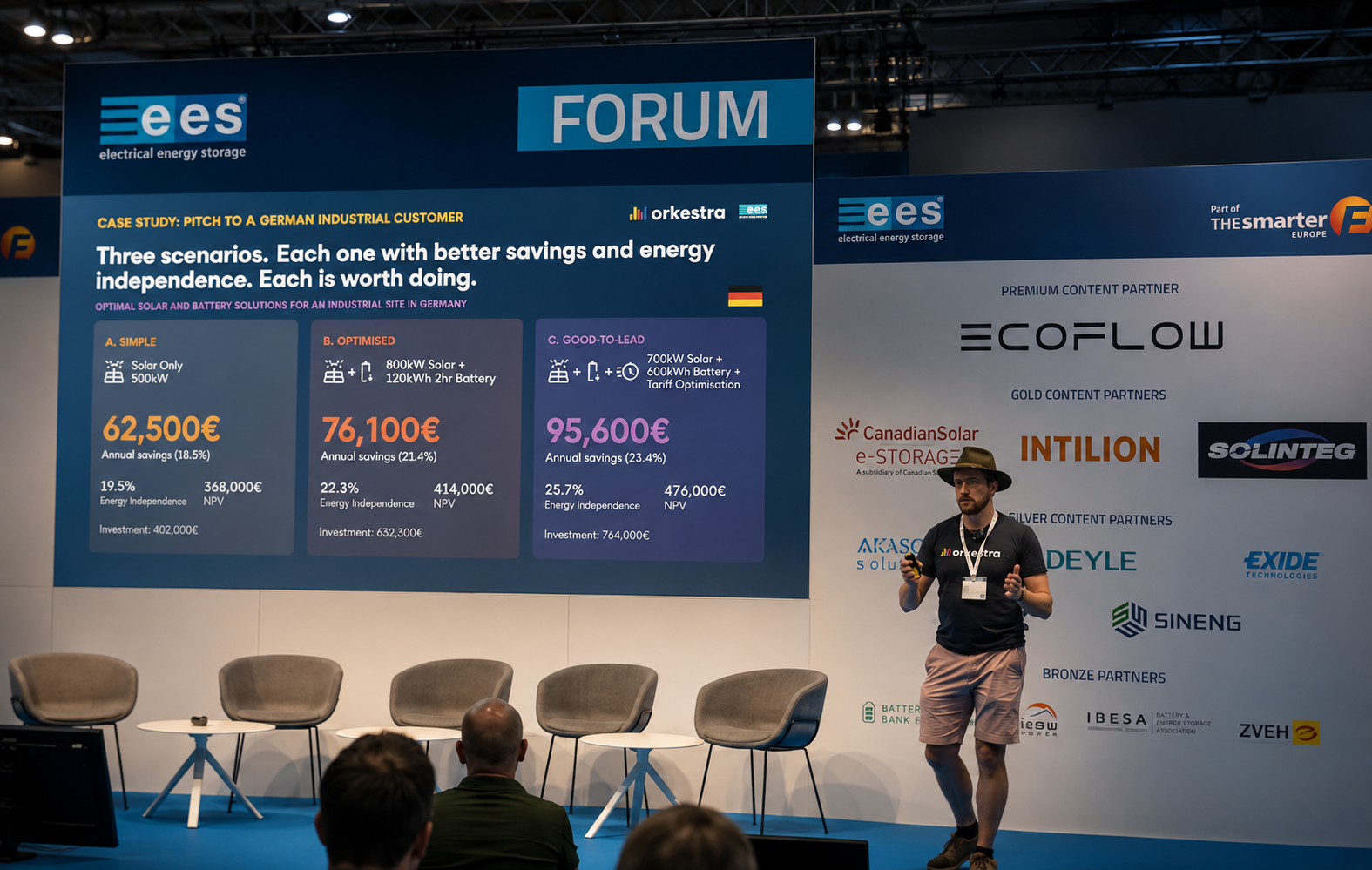
At Intersolar/ees Europe in Munich, our Co-CEO James Allston broke down both sides of that equation — what's transferable across markets, and where you need to build the playbook from the ground up.
Watch the full presentation below, and read on for the key takeaways.
Keen to see how your next commercial solar and battery project stacks up? We offer a free 3 week trial of Orkestra (no credit card required) so you can get start modelling in your local market today.
Get your 3 week free trial
Get started exploring energy project feasibility analysis and reporting. Sign up now - no credit card required.
Sign up todayKey Takeaways
1. The C&I solar business model in Europe is shifting — and the new one is better
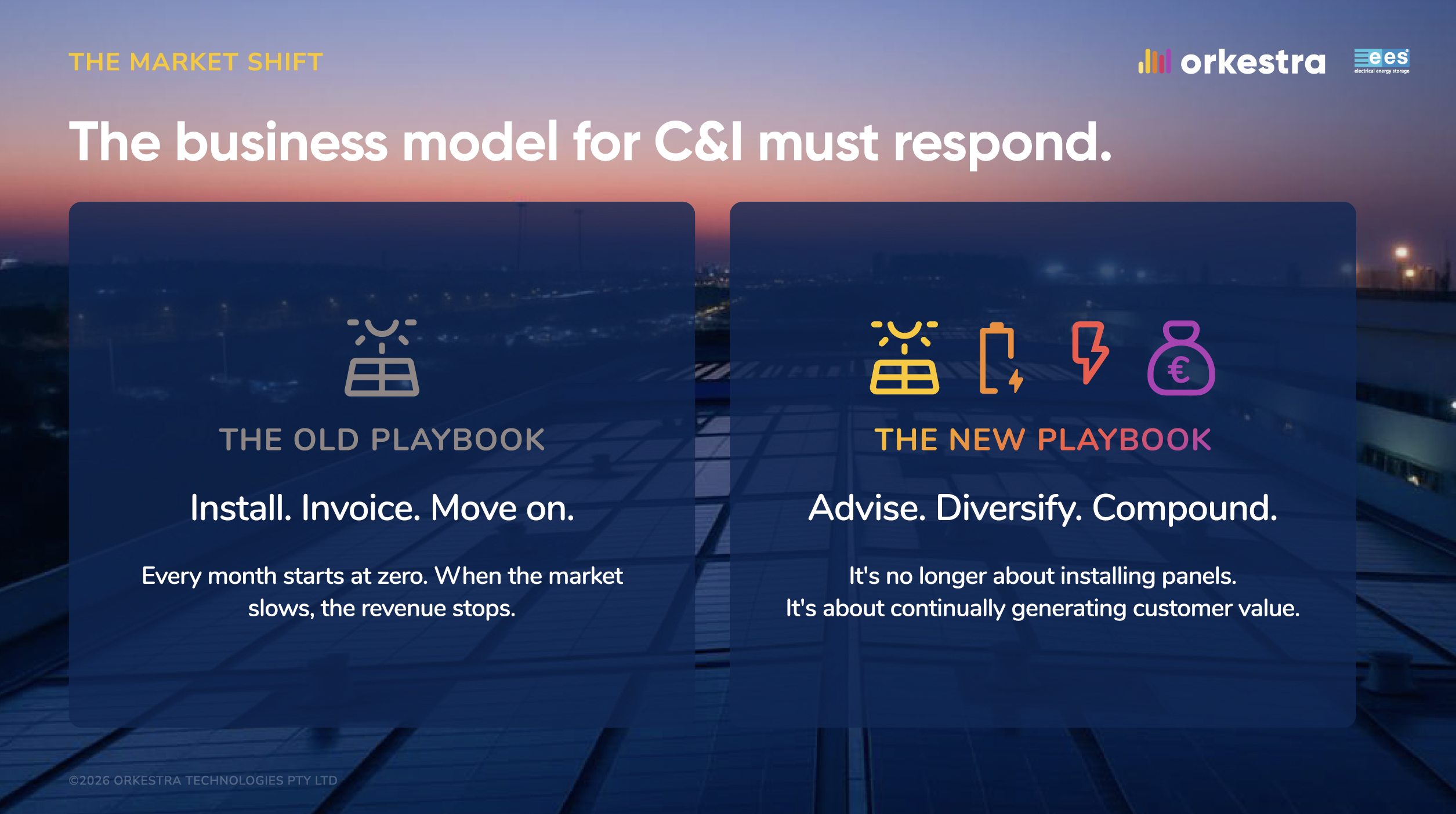
The traditional install-invoice-move-on model has served the industry well, but it creates a business that starts every month at zero. When market conditions tighten, revenue stops. The installers and developers growing fastest right now have made a fundamental shift: they've become long-term energy advisors to their customers rather than one-time contractors.
The new playbook centres on three things: advise, diversify, and compound. It means thinking holistically about what a customer actually needs, bringing batteries and tariff optimisation into the conversation alongside solar, and treating each project as the beginning of a long-term relationship rather than the end of a transaction.
Every system you commission is an opportunity to deliver ongoing value, identify the next upgrade, and deepen the relationship.
This is the flywheel model, and it creates a fundamentally more resilient, more profitable business.
2. Multi-asset solutions dramatically increase customer value — and your revenue
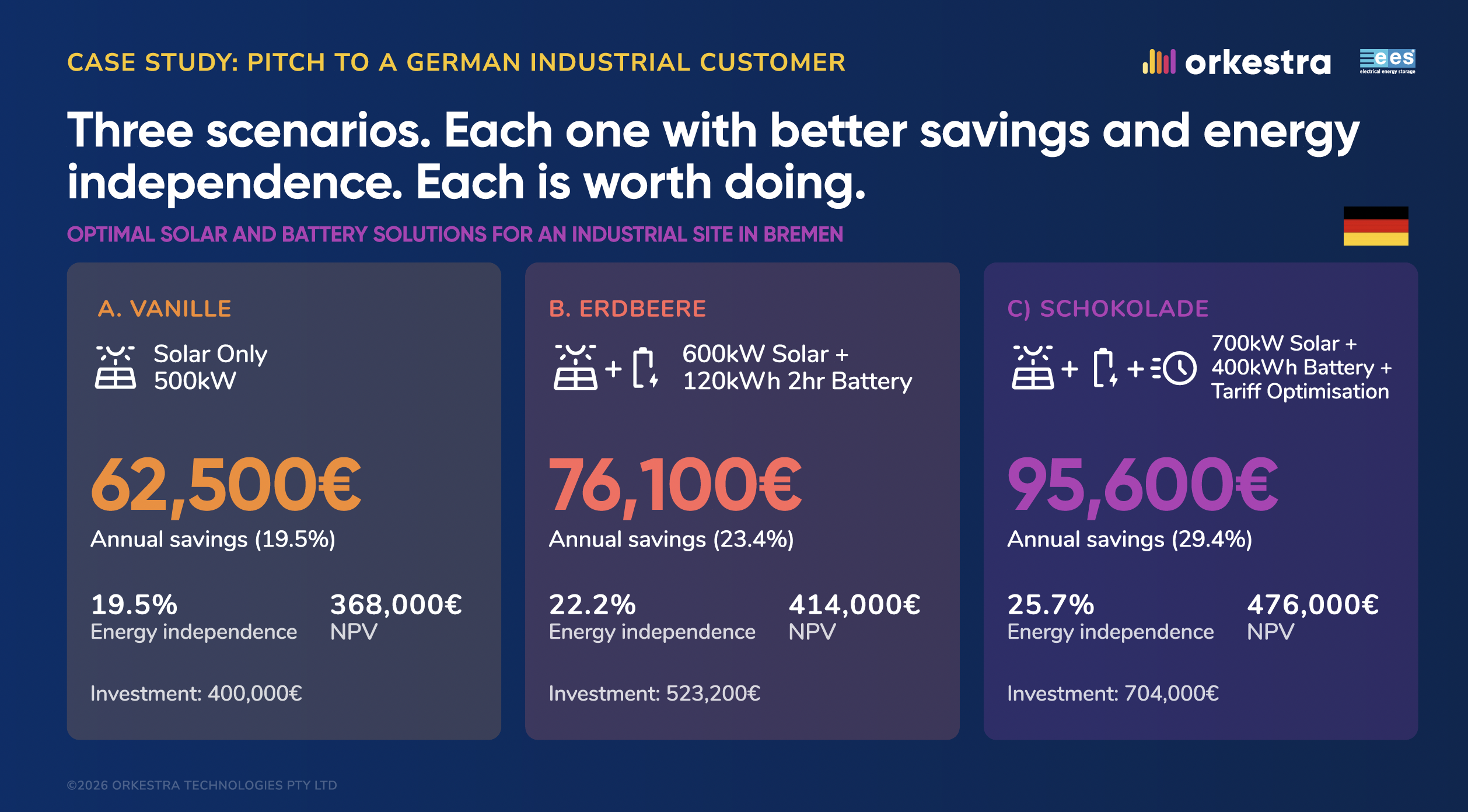
One of the most compelling parts of James's presentation is the worked example of a German industrial site in Bremen, which illustrates what the multi-asset approach actually delivers in practice.
Starting with solar only — a solid 500kW system — the customer sees €62,500 in annual savings and 19.5% energy independence. A good investment. But add a battery and upsize the solar system, and annual savings jump to €76,100, with energy independence improving further. Crucially, the battery also improves the economics of the solar system itself, by capturing generation that would otherwise have been lost to curtailment.
Then add tariff optimisation — switching the customer to a tariff that actually rewards the flexibility the battery creates — and annual savings reach €95,600, nearly 30% of the customer's total energy bill. The investment grows from €400,000 to €704,000, but the NPV increases from €368,000 to €476,000, and the installer has nearly doubled their revenue from a single customer.
The whole is significantly greater than the sum of its parts. Thinking multi-asset doesn't just help the customer — it transforms the commercial opportunity.
3. There is no single European battery value stack — and that matters
This is the part of James's presentation that most people underestimate, particularly for businesses operating or expanding across multiple European markets.
The battery value stack — the specific combination of revenue streams and cost savings that make a battery storage system financially compelling — is fundamentally different in each country. In Germany, it centres on optimising demand and protecting EEG revenue when wholesale prices go negative. In the UK, it's about time-of-use energy arbitrage and Capacity Market Levy reduction. In France, the focus shifts to reducing excess consumption charges, while in the Netherlands it's about maximising network connection utilisation.
These aren't minor variations — they're structurally different business cases, driven by different tariff regimes, grid structures, and market rules. A model that works in Berlin won't automatically work in Paris or London without being rebuilt from the ground up for each market.
For businesses thinking about European expansion, this means doing the work market by market. The playbook has to be country-specific to be credible, and that requires both data and expertise in each geography. It's also where Orkestra becomes a very valuable resource!
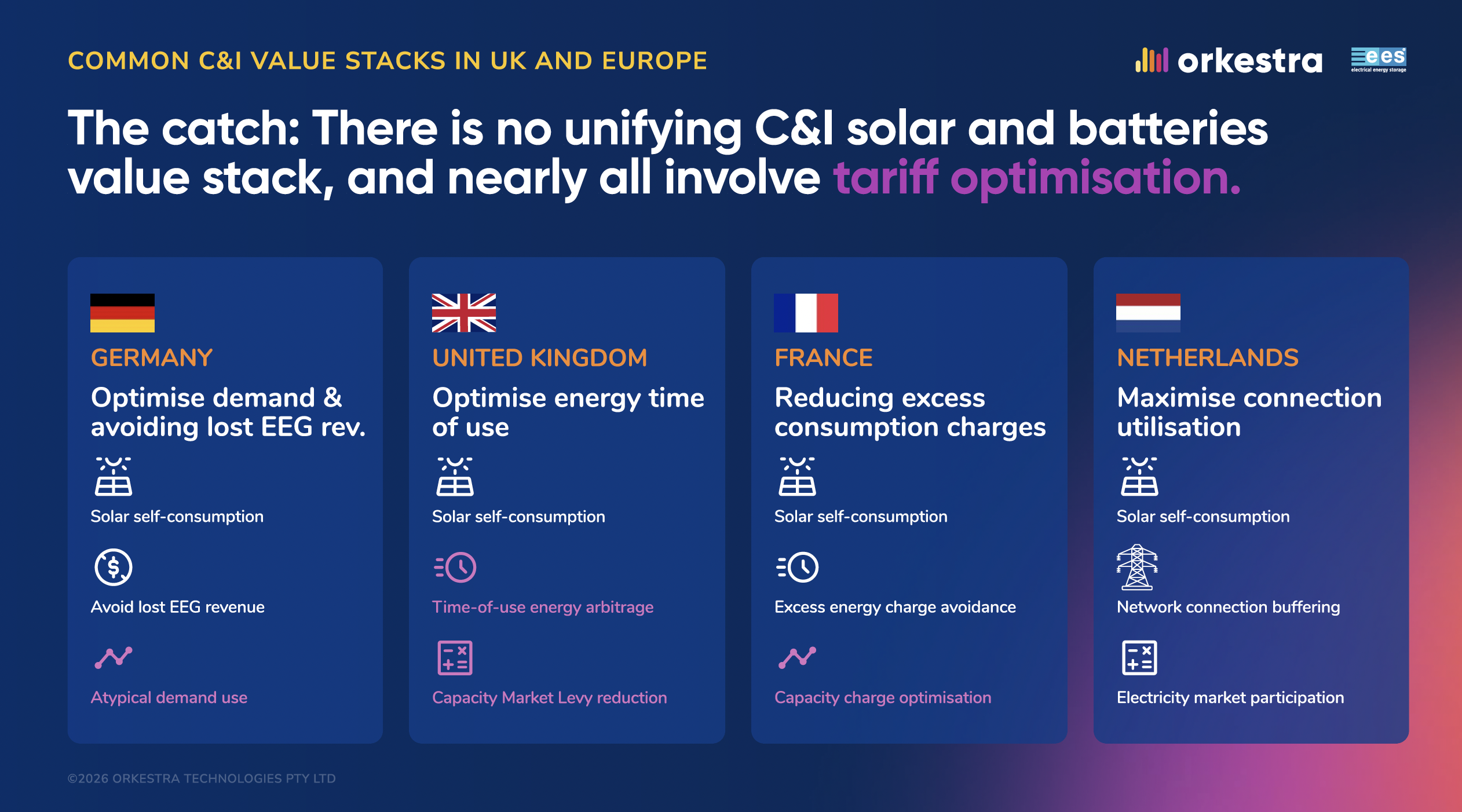
[Image: Common C&I value stacks across UK and Europe slide — alt text: "Comparison of C&I solar and battery value stacks across Germany, UK, France and Netherlands"]
Turning the Playbook into Practice
Understanding the new playbook is one thing. Executing it at scale across multiple sites, multiple asset types, and multiple markets, is where most teams hit a ceiling.
Modelling the right combination of solar capacity, battery size, and tariff structure for each customer, in each country, and building a business case that a commercial decision-maker can act on is not something you can manage in spreadsheets.
Orkestra's energy intelligence platform is designed to make this executable at scale. Orkestra Plan takes site energy data and runs hundreds of solar, battery, and tariff combinations simultaneously, surfacing the optimal solution with full financial outputs: NPV, IRR, payback period, annual savings, and energy independence — presented in a format built for the customer conversation, not the engineering team.
Orkestra Operate then tracks the real-world financial performance of installed systems, comparing actual savings against forecast so you can demonstrate ongoing value and identify the right moment to propose the next phase.
Together, they close the loop between planning and performance — and make the flywheel turn.
Start a free trial or book a one-on-one with our team to see how Orkestra can support your business in C&I solar across Europe.
Get your 3 week free trial
Get started exploring energy project feasibility analysis and reporting. Sign up now - no credit card required.
Frequently Asked Questions
What is a battery value stack in C&I solar?A battery value stack refers to the combination of revenue streams and cost savings a battery storage system can generate at a specific site. This includes solar self-consumption, time-of-use energy arbitrage, demand charge reduction, network charge avoidance, and in some markets, participation in ancillary service or wholesale markets. The value stack varies significantly by country due to differences in tariff structures and grid regulations.
Does adding battery storage improve the returns on a C&I solar system? Yes. In markets where curtailment is a risk — particularly in Germany, where EEG subsidies are no longer paid when wholesale prices go negative — a battery can actually improve the financial performance of the solar system by storing generation that would otherwise be lost. Combined with tariff optimisation, the addition of battery storage can increase annual customer savings by 50% or more compared to a solar-only installation.
What is the difference between Orkestra Plan and Orkestra Operate? Orkestra Plan is used at the pre-sale and design stage — it models solar, battery, and tariff scenarios for a customer site and generates a business case with full financial outputs. Orkestra Operate is used post-installation — it monitors the financial performance of commissioned systems, tracks savings against forecast, and identifies opportunities for the next phase of investment.