Blog /
Industry Insights
MiSpeL is live in Germany - here’s how to make sure your project modelling accounts for it
October 5, 2026

Until now, drawing a single kilowatt-hour from the grid into a battery could put the EEG support for an entire solar-plus-storage system at risk. For that reason, many batteries paired with solar installations were deliberately blocked from charging from the grid, which left flexibility that the market is willing to pay for unused.
As of today, that's history.
On 1 October 2026, Germany's Federal Network Agency (Bundesnetzagentur) adopted its final MiSpeL determination (Marktintegration von Speichern und Ladepunkten).
For the first time, storage systems and bidirectional charging points can draw power from the grid and export it back without losing EEG support on the solar share.
MiSpel: What's changing?
Previously, the exclusivity option applied: a battery had to be strictly isolated from grid power to stay subsidy-eligible. MiSpeL replaces that with two new paths:
- Allocation option - separates green and grey electricity using quarter-hourly meter readings and is open to all system types and sizes.
- Flat-rate option - reduces metering effort for solar installations up to 30 kWp, although it only becomes available once the EU Commission has granted state aid approval.
In both cases the battery can mix sources, provided the EEG-eligible share remains clearly attributable.
For commercial and industrial projects above 30 kWp, the allocation option is the route that applies.
What this means for your solar and storage projects
The separation of green and grey electricity is a calculation in its own right and sits at the centre of the project economics.
Quarter-hourly values, market revenue, market premium and the EEG-eligible share must be reconciled for every time step, which is not realistic to do by hand or in a spreadsheet for a real project.
A transition rule also applies until 30 September 2027: using MiSpeL still requires the agreement of both the grid operator and the metering point operator, so timelines and approvals belong in your project planning alongside the financials.
How Orkestra Plan models MiSpeL
Plan now models batteries under the MiSpeL allocation option as part of its EEG feed-in tariff modelling.
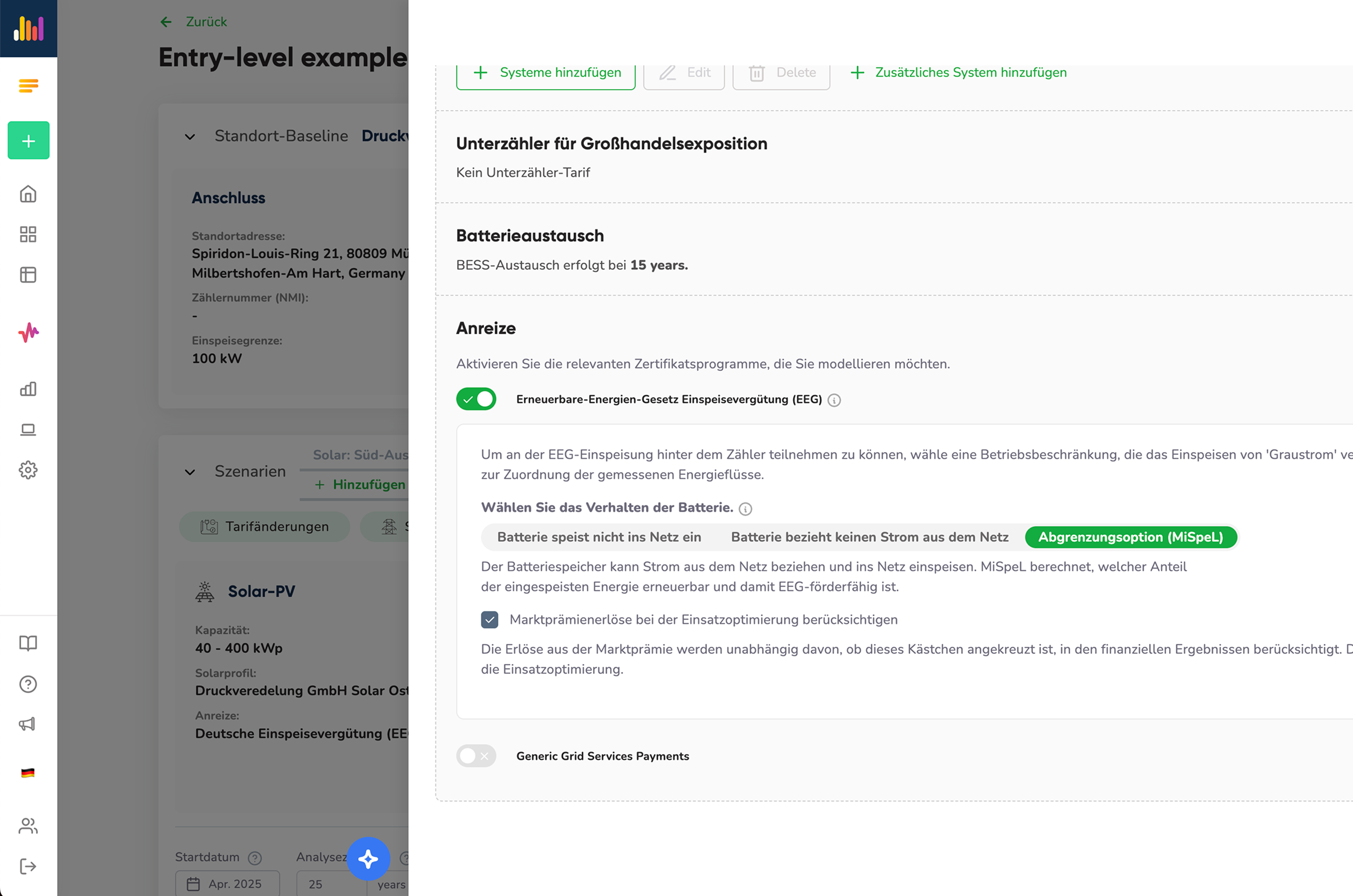
The calculations are simple to apply thanks to Orkestra. Select Allocation option (MiSpeL) in the battery's EEG settings to indicate the battery will be charging from and exporting to the grid. The model calculates the renewable share of exports that is eligible for EEG support, so you can assess more flexible battery operation on realistic numbers.
To help you understand and communicate the impact of the new regulations, your project results now also come with two new charts and a detailed table.
Chart 1: EEG revenue breakdown — see the revenue breakdown between wholesale revenue and market premium.
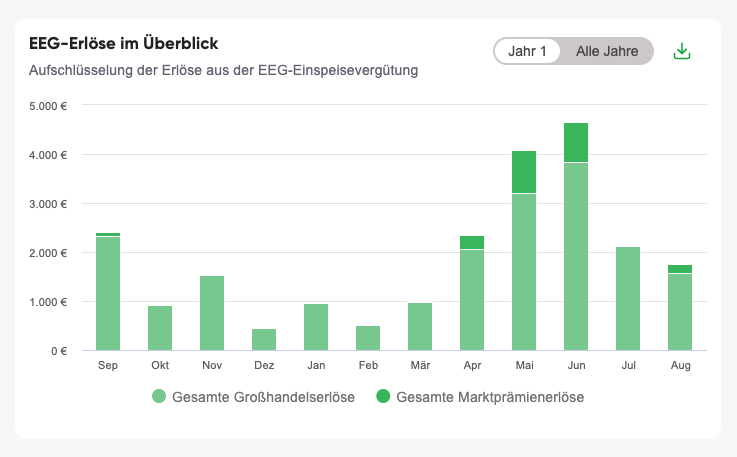
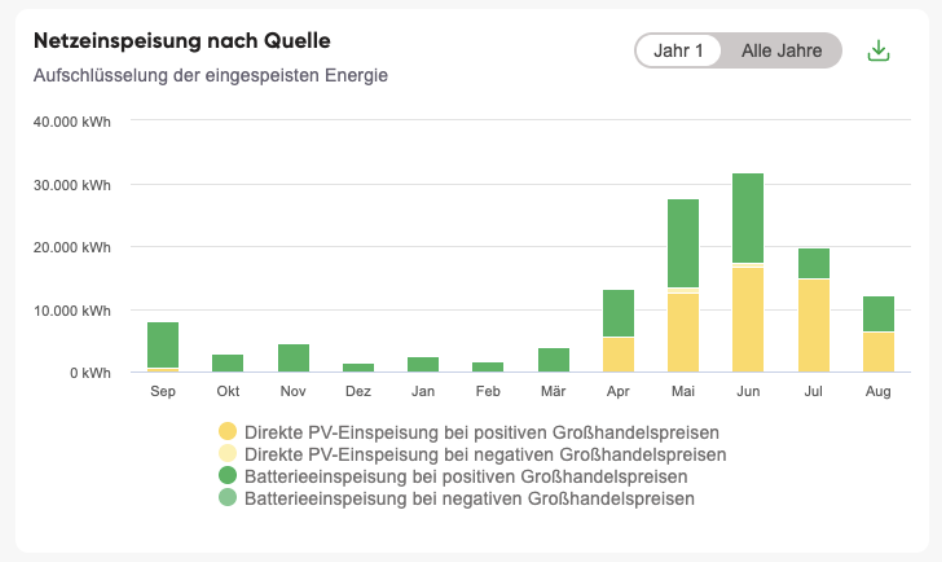
Chart 2: Grid exports by source — see how much exported energy comes directly from solar and how much comes from the battery, as well as whether the energy is exported during periods of positive or negative wholesale prices.
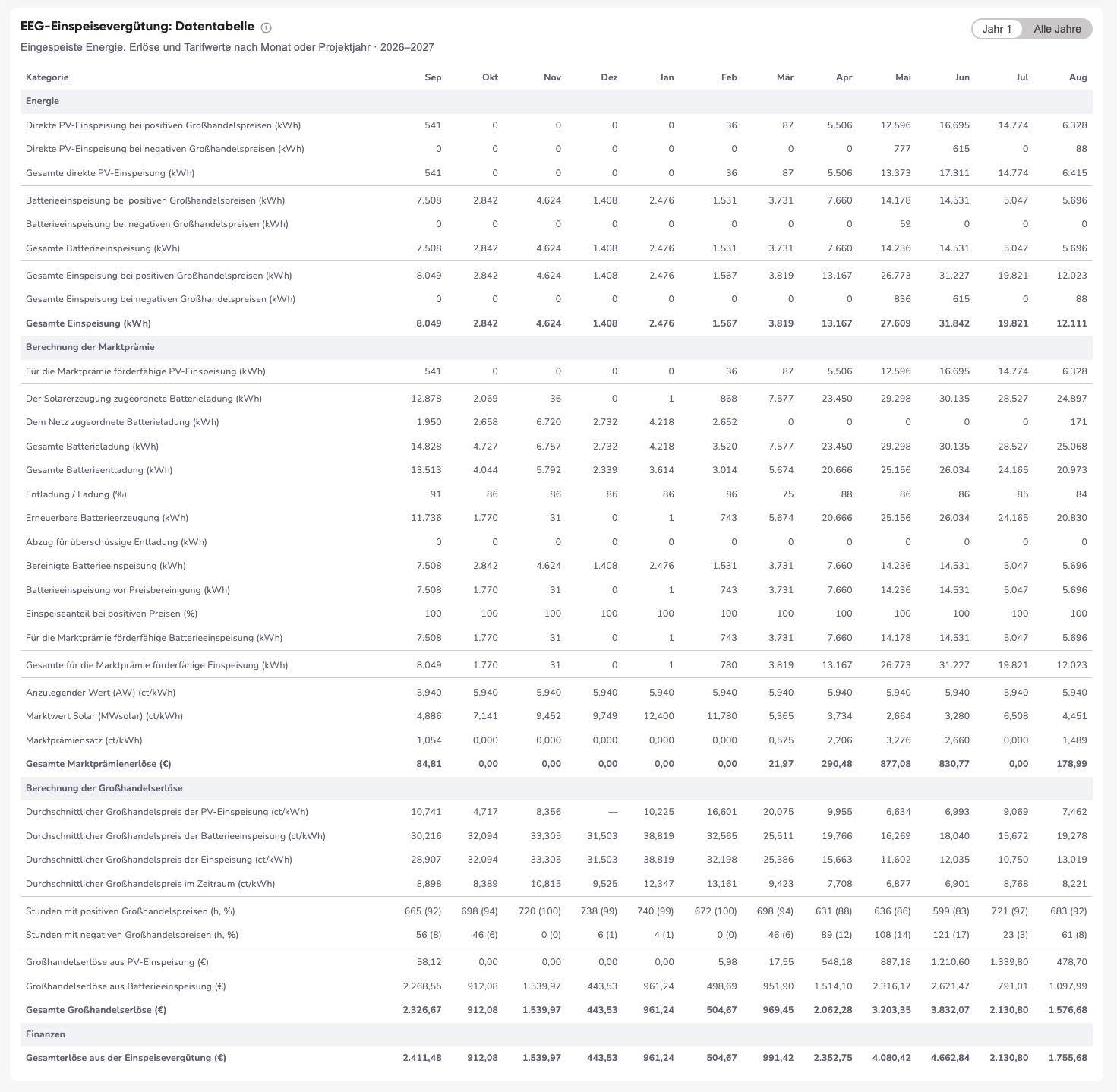
EEG feed-in tariff data table — this explains the details of the outputs from the simulation, as well as the step-by-step financial calculations, including MiSpeL battery allocation, market premium calculation and wholesale revenue calculation. The table allows you to trace how energy flows translate into earnings.
To get started, enable EEG under your scenario's solar incentive settings and add wholesale price data in the Forecast section. Then choose your battery's EEG operating mode (no import from the grid, no export to the grid, or Allocation option (MiSpeL)), run the scenario and review the charts and table in Results Explorer.
Because you can run all three modes side by side, you can see which one delivers the strongest return under the new rules rather than estimating it.
Test how MiSpeL impacts the economics of your next C&I project
If you have a solar and storage project coming up, start a free trial of Orkestra and run a feasibility assessment that reflects the new regulations from the outset. Start your free trial.