Blog /
Industry Insights
How to Sell Batteries with PPAs in the UK
August 28, 2026

Most PPA providers in the UK sell on price. Lead with the lowest pence per kilowatt hour, win the deal. That works fine for solar-only proposals, but it falls apart the moment batteries enter the conversation
.
Batteries raise the PPA rate. They have to, because the system costs more. A customer comparing headline p/kWh will pick the cheaper option every time, even when the battery option saves them more money and covers more of their load. The pitch structure, and specifically what number you lead with, is what decides whether the battery gets sold or dropped.
This post breaks down how to structure a solar-plus-battery PPA pitch that doesn't stall the deal. It's based on a webinar we ran recently, and includes a worked case study modelled in Orkestra Plan: three system configurations for the same site, each solved for the same 12% provider return, so the comparison is fair.
The context matters.
UK electricity prices are still 70% above pre-2021 levels, and about 50% higher than France and Germany. Two major shocks in four years, the Ukraine invasion in 2022 and the Middle East in 2025, have made one thing clear to every finance director watching their energy bill: the next shock is a matter of when, not if.
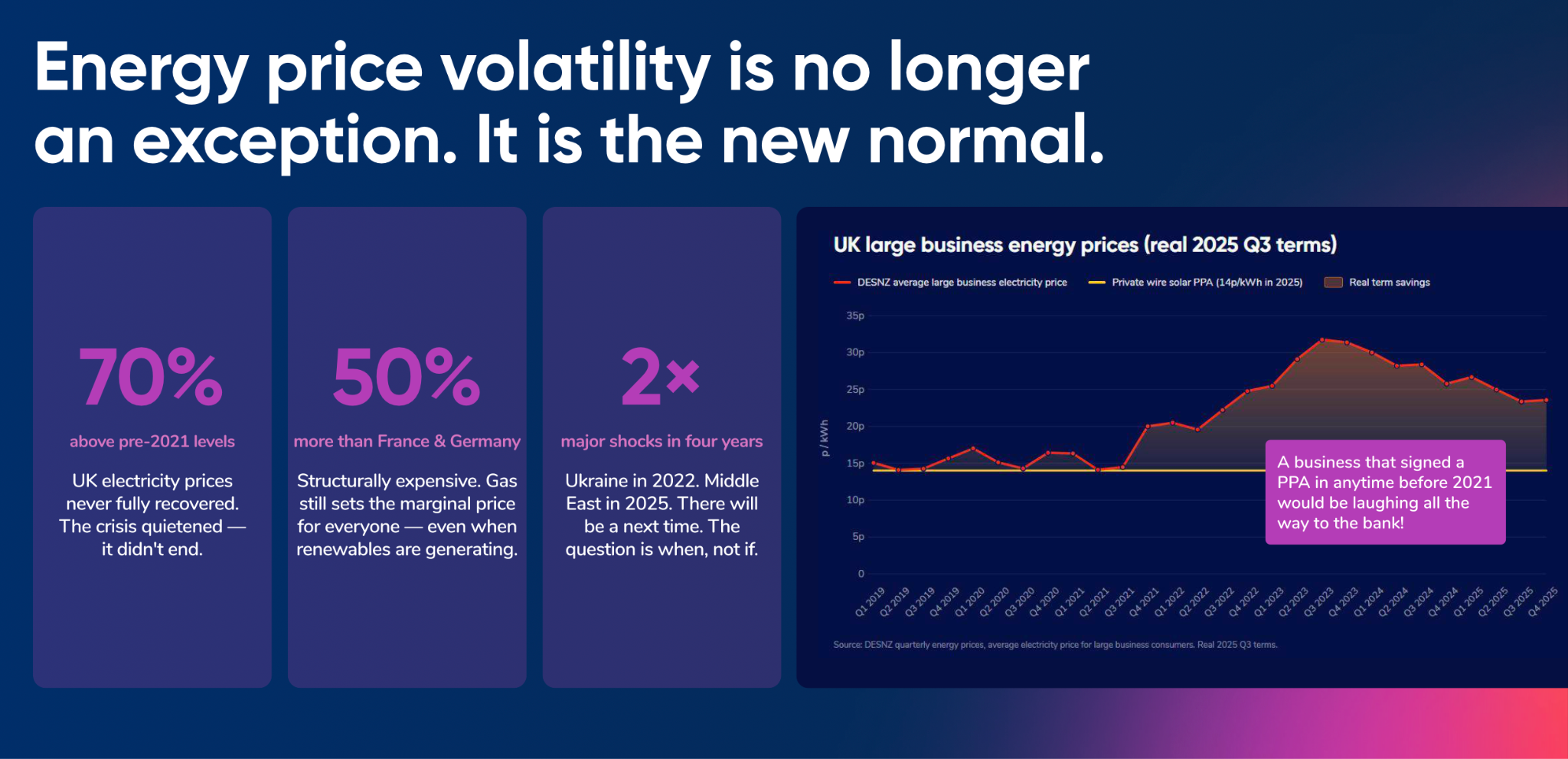
That backdrop should be good news for PPA providers. Businesses want to lock in a price and stop worrying about what happens next. We've written before about what that volatility means in practice for UK businesses, in The case for UK business energy independence. But across the UK market, providers who lead with the lowest pence per kilowatt hour are losing deals, and leaving value on the table when they win them.
The p/kWh trap
Lead with price and you invite the customer to shop on price. It becomes a race to the bottom, and it actively works against you the moment batteries enter the conversation.
Take two options for the same site:
- Solar only: 500kW system, PPA rate of 9.8p/kWh
- Solar and battery: 700kW solar plus a 200kWh battery, PPA rate of 11.1p/kWh
On a headline p/kWh comparison, option A wins every time. The battery option has to cover a larger cost base, so the rate goes up. A customer anchored on price alone will pick the cheaper number and pass on the battery, even though the battery option is the better deal once you look past the rate.
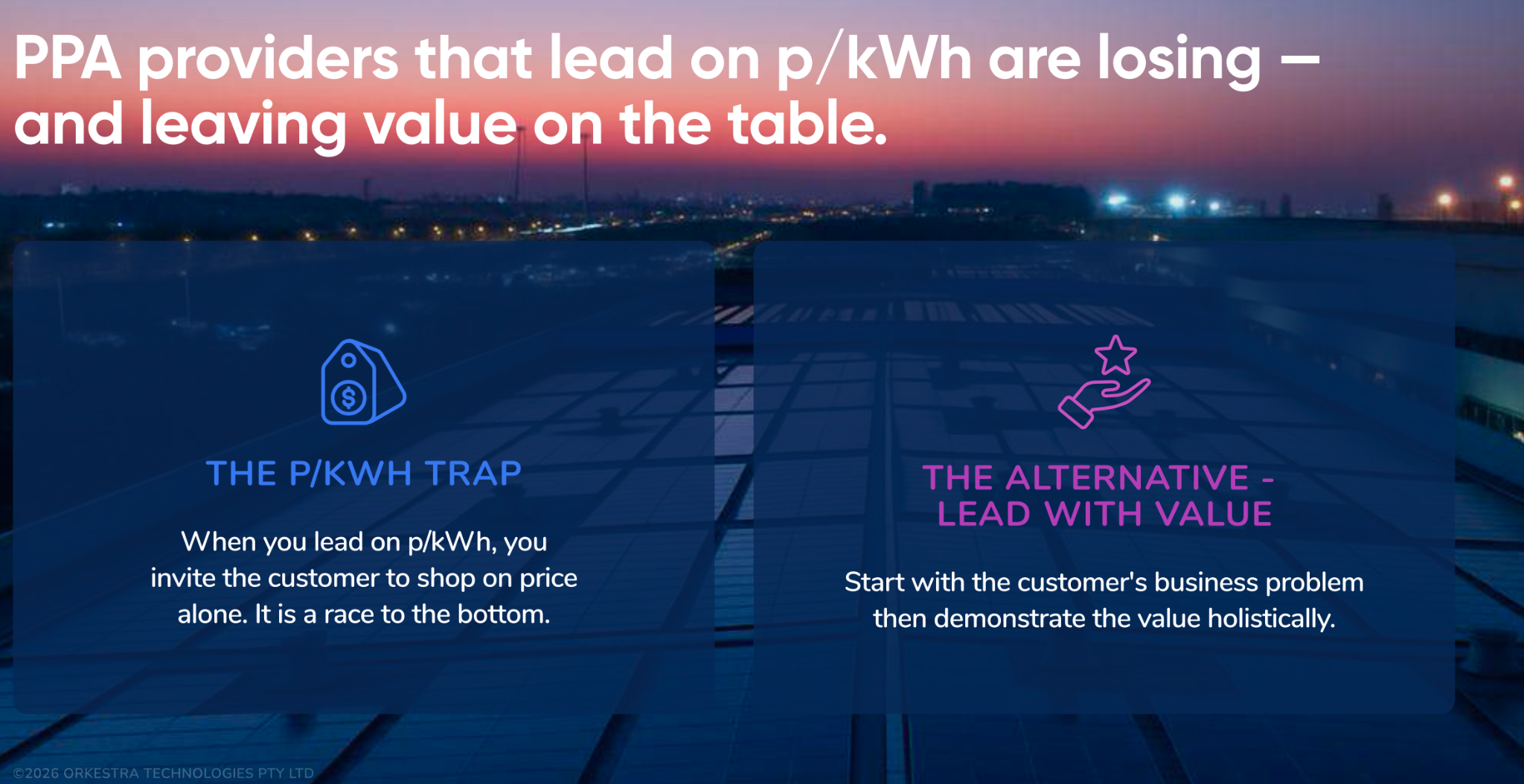
That's the core problem for the industry: a narrow focus on p/kWh makes it structurally hard to sell the benefits of storage, because storage will never win on that single metric.
Understanding why customers buy a PPA in the first place
Before fixing the pitch, it's worth being clear on who's buying and why. PPA buyers are typically:
- A financial buyer at a large business, looking to lock in energy costs for the long term
- Increasingly focused on the carbon benefits, especially at organisations with ESG commitments
- Keen to have a third party own and operate the system, removing the maintenance and operational burden
Put together, PPA buyers want price certainty at low risk. Not the lowest possible number, certainty. That distinction should shape the order you present options in and the numbers you lead with.
A pitch structure that doesn't stall the deal
Selling a solar PPA is hard enough on its own. Adding complexity before the solar is agreed can stall the whole deal, and a few common habits are usually to blame:
- Leading on p/kWh, which invites a price-only comparison
- Bundling solar, battery and tariff into a single ask
- Opening the battery conversation before the solar is even agreed
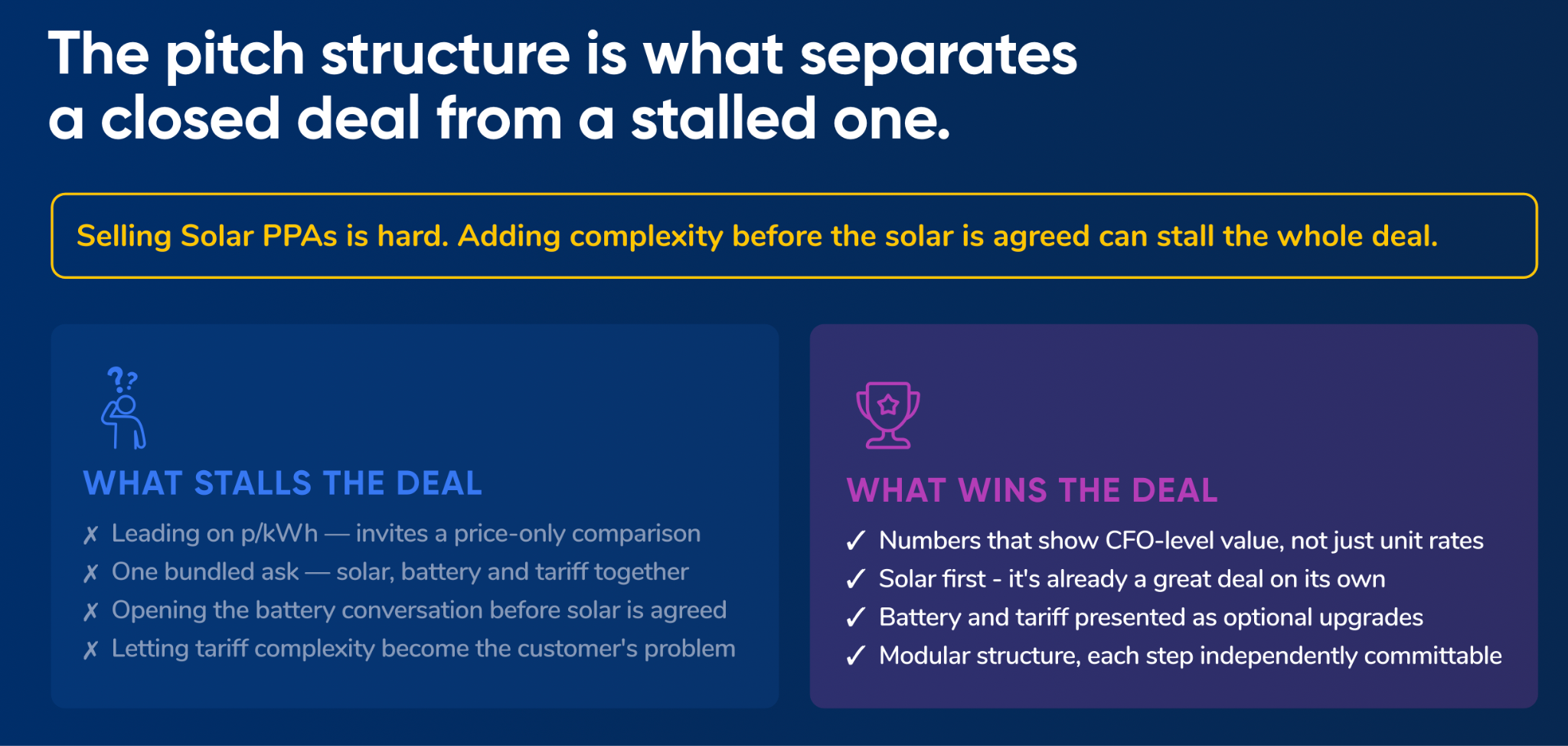
The fix is a structured, tiered approach that lets the customer choose their own ceiling: a solar-only base case that has to stand on its own, then a battery, then tariff optimisation, each layered in as a separate, independently committable step.
Access the full framework to structure your pitch for success here.
Get your 3 week free trial
Get started exploring energy project feasibility analysis and reporting. Sign up now - no credit card required.
Sign up todayCase Study
To show what the theory above means in practice, we modelled three PPA structures against a real UK site: Amped Up Parts, a 5-day manufacturer using 1.2GWh a year (around 500kW of demand), on a full passthrough tariff, paying roughly £250,000 a year for electricity.
We compared three system sizes for that one site, solar only, solar plus a battery, and solar plus a battery with tariff optimisation, and solved each so the PPA provider earns the same 12% rate of return in every case. That control matters: it means any difference in outcome comes from the system design, not from the provider taking a thinner margin to look competitive.
It's also the kind of comparison that's hard to do, running three configurations against one another and holding the provider's return constant across all of them is what Orkestra's Plan product is built for, so the output is a feasibility case a CFO and a financier can both trust, not just a rough estimate. See it in action with your own numbers - Start a free 3-week trial today.
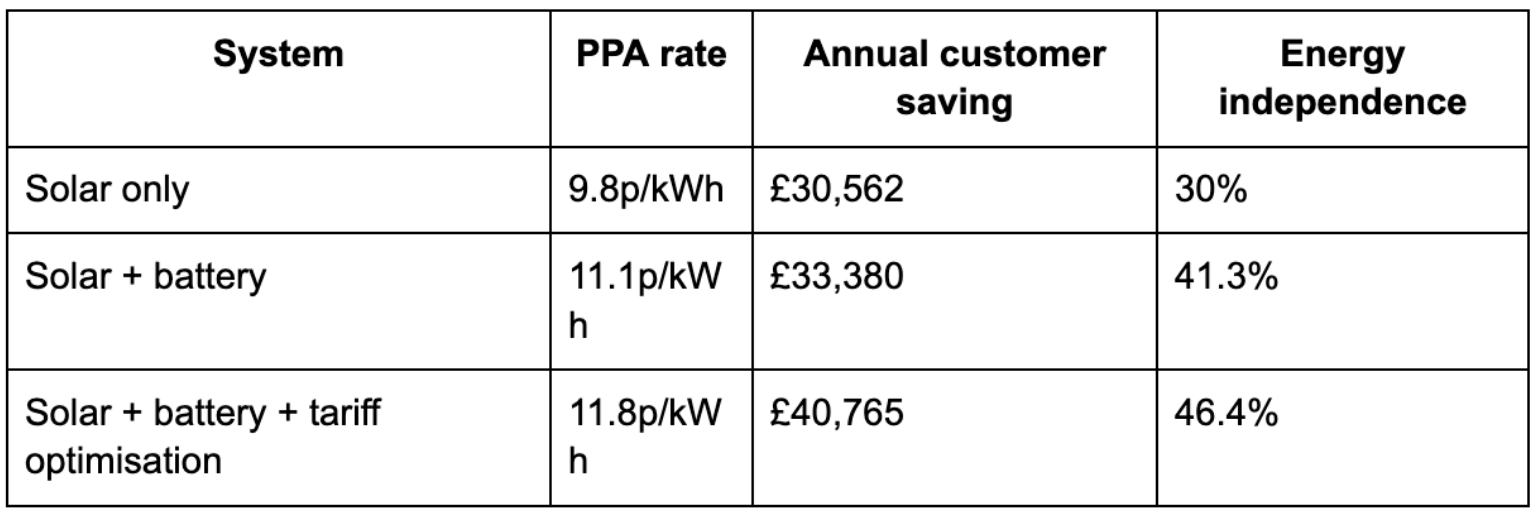
Two things stand out.
1. the PPA rate rises at every step, which is exactly what a price-only comparison would flag as a worse deal.
2. The customer's saving rises faster than the rate does: moving from solar only to the fully optimised system takes annual savings up by 33%, and energy independence from 30% to over 46%. The system that looks most expensive on a p/kWh basis is the one that saves the customer the most money.
The same three scenarios also hold up from the provider's side. Capital deployed increases at each step, but the rate of return stays fixed at 12% throughout. Scaling up the system doesn't dilute the provider's returns, so there's no financial reason to hold back on presenting the larger option.
Where the tariff-optimised option pulls ahead
Look closer at the jump between the two battery scenarios above, and the pattern is worth explaining.
Adding a battery on its own lifts annual savings by roughly £2,800, from £30,562 to £33,380. Adding tariff optimisation on top of that same battery lifts savings by roughly £7,400 more, to £40,765, a bigger gain than the battery delivered by itself.
The difference is how the battery is used, not how big it is. A battery without tariff optimisation simply absorbs surplus solar during the day and discharges it as soon as demand exceeds generation, which is easy to explain to a customer but leaves value unused.
Add a time-of-use tariff and an energy management system, and the same battery can be aimed specifically at the site's peak pricing window instead of discharging opportunistically. On the site modelled here, the peak rate was 71% higher than the day rate, so timing the discharge to hit that window is what drives the extra saving.
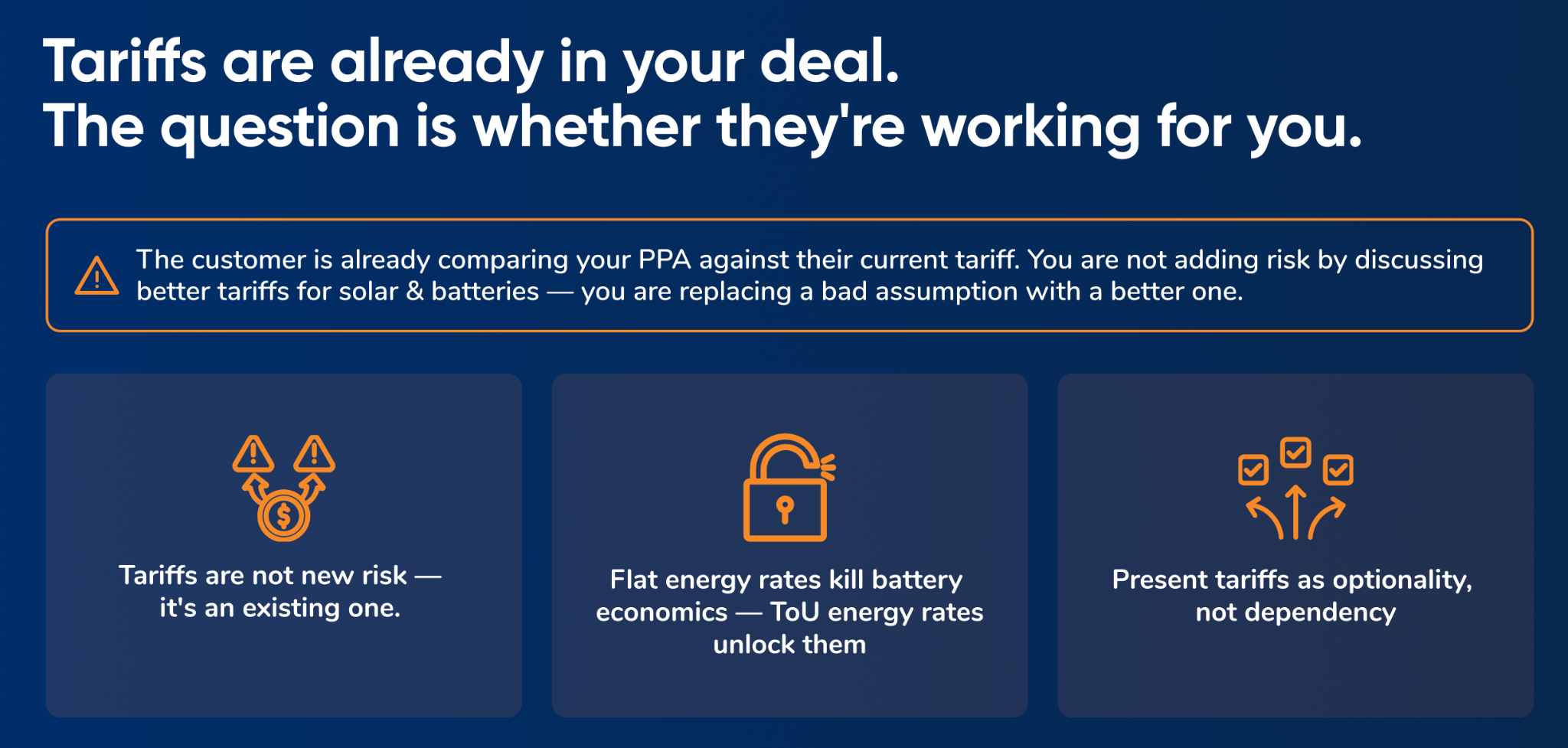
Tariff optimisation is optional and can be added after the system is installed. It isn't a condition of the PPA, but the numbers above are the reason it's worth raising once the solar and battery are agreed, rather than leaving it out of the conversation entirely.
Important to remember
Adding a battery to a take-or-pay structure doesn't meaningfully change the PPA provider's exposure:
- Solar output is still the main driver of value for the provider
- The customer carries the risk of battery performance
- The provider's job is to make sure the battery is deployed with an energy management system capable of doing that job
Before committing to a battery hardware partner, it's worth asking any EMS provider three questions: can it forecast load, can it forecast solar, and can it forecast against a tariff.
How we can help
One thing worth carrying forward from the session: not every battery project is going to stack up, and knowing which ones will, fast, matters as much as the pitch itself. It's not just about speed, it's about whether the numbers will actually hold up when someone else has to sign off on them.
That's exactly what the Orkestra Plan is built for. It runs up to 250 solutions in under 60 seconds, so you can filter out what won't work and back what will with a full revenue breakdown a financier can trust. See it in action today - book a demo with team.
Plan is the starting point, but the value doesn't stop once a deal closes. Orkestra's energy intelligence platform supports the full customer lifecycle:
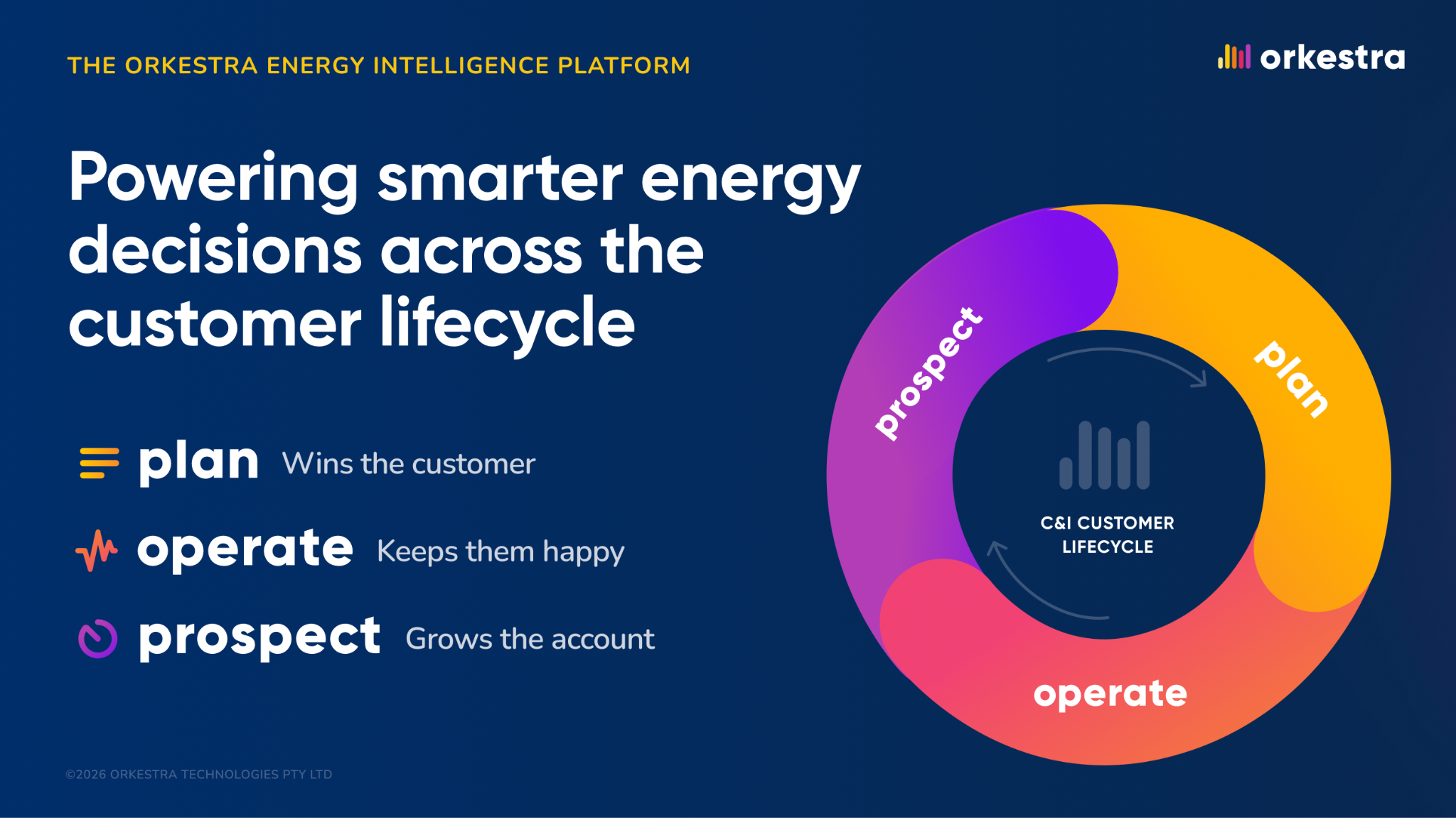
- Plan wins the customer.
Model solar, battery and tariff scenarios side by side for a site, and generate the business case that supports a PPA decision, the same modelling used to build the Amped Up Parts scenarios above. - Operate keeps them happy.
Track the financial and operational performance of every asset once it's deployed, against what was modelled, so the value promised in the PPA is the value delivered. - Prospect grows the account.
Use live performance data from Operate to identify which existing customers are ready for a battery, a tariff change, or additional solar, and approach them with evidence from their own site.
Plan, Operate and Prospect feed into each other. A stronger business case at the Plan stage leads to a better-performing asset in Operate, which becomes the evidence base for the next deal through Prospect.
Book a Demonstration
Book a meeting with the Orkestra team in your region
Dive Deeper
This blog covers the shape of the problem. Our webinar, How to Sell Batteries with PPAs in the UK, covers the rest: the full three-tier pitch structure, the complete numbers for both the customer and the PPA provider, and a live walkthrough of how the Amped Up Parts scenarios were built and compared in Orkestra's energy intelligence platform.
Watch the full webinar recording here.
If you'd rather see it against your own site data straight away, you can start a free trial and run the scenarios yourself. Start your free trial.