Blog /
Industry Insights
Model NSW Peak Reduction Certificates in Orkestra Plan
August 5, 2026

Big batteries are about to get a lot cheaper in NSW thanks to the Peak Demand Reduction Scheme (PDRS), and we're ready to help you capture it using Orkestra Plan
From 1 September 2026, the NSW PDRS will expand to cover commercial-scale batteries, from 20 kWh all the way up to 30 MWh of usable capacity. What does this mean? It means apartments and businesses across NSW can now claim significant upfront discounts on battery installations through Peak Reduction Certificates (PRCs).
Between PRCs, the Cheaper Home Batteries Program, and the SRES expansion from 100 kW to 1 MW from 1 October 2026, there's a lot landing at once. Plan models all of these together, so you can size the right system and see the real ROI for each site.
For a lot of your customers, these incentives will significiantly change whether a commerical solar and battery system stacks up. The PDRS kicks in on 1 September, the pipeline is about to get busy, and the installers quoting first will win the work.
Below, we break down the scheme and how to model it in Orkestra, stack it against other incentives, and ultimately find the right size and best value system for your customers.
How the PDRS will impact the feasibility of your commercial projects
Battery paybacks have always been the hard sell. PRCs solve this, landing as a CAPEX discount in month 0, straight off the upfront cost of the system. And the value stacks:
- STCs too: PRCs can be combined with STCs under the federal Cheaper Home Batteries Program for systems up to 100 kWh.
- Solar sweetener: Solar isn't required, but pairing an eligible solar system within 90 days generates extra PRCs.
More certificates, lower upfront cost, faster payback — a stronger yes for the customer.
The catch: it's genuinely complex to calculate
The value scales with battery size, but the rules don't run in a straight line. There are three activity types (BESS3 for apartments, BESS4 for small/medium business, BESS5 for commercial & industrial), two different caps depending on activity, distribution-network variables, and a certificate price that moves with a live market spot rate. Getting it wrong means quoting the wrong number.
How the scheme works
Under the PDRS (Amendment No. 2) Rule 2026, Accredited Certificate Providers (ACPs) create and sell PRCs to scheme participants, enabling an upfront discount on the customer's battery installation. Three activity types cover the range:
- BESS3 (Apartments): usable battery capacity greater than 20 kWh and not more than 200 kWh. Rewards are capped at 5 kWh per dwelling.
- BESS4 (Small & Medium Businesses): usable battery capacity greater than 20 kWh and not more than 200 kWh.
- BESS5 (Commercial & Industrial): usable battery capacity greater than 200 kWh and not more than 30,000 kWh. Rewards are capped at the first 10,000 kWh (10 MWh) of usable capacity, even though eligibility extends to 30 MWh.
The certificate price is a live spot market rate. Treat the default in Plan as an estimate and confirm current pricing with your ACP before finalising a customer quote.
We've done the hard part for you
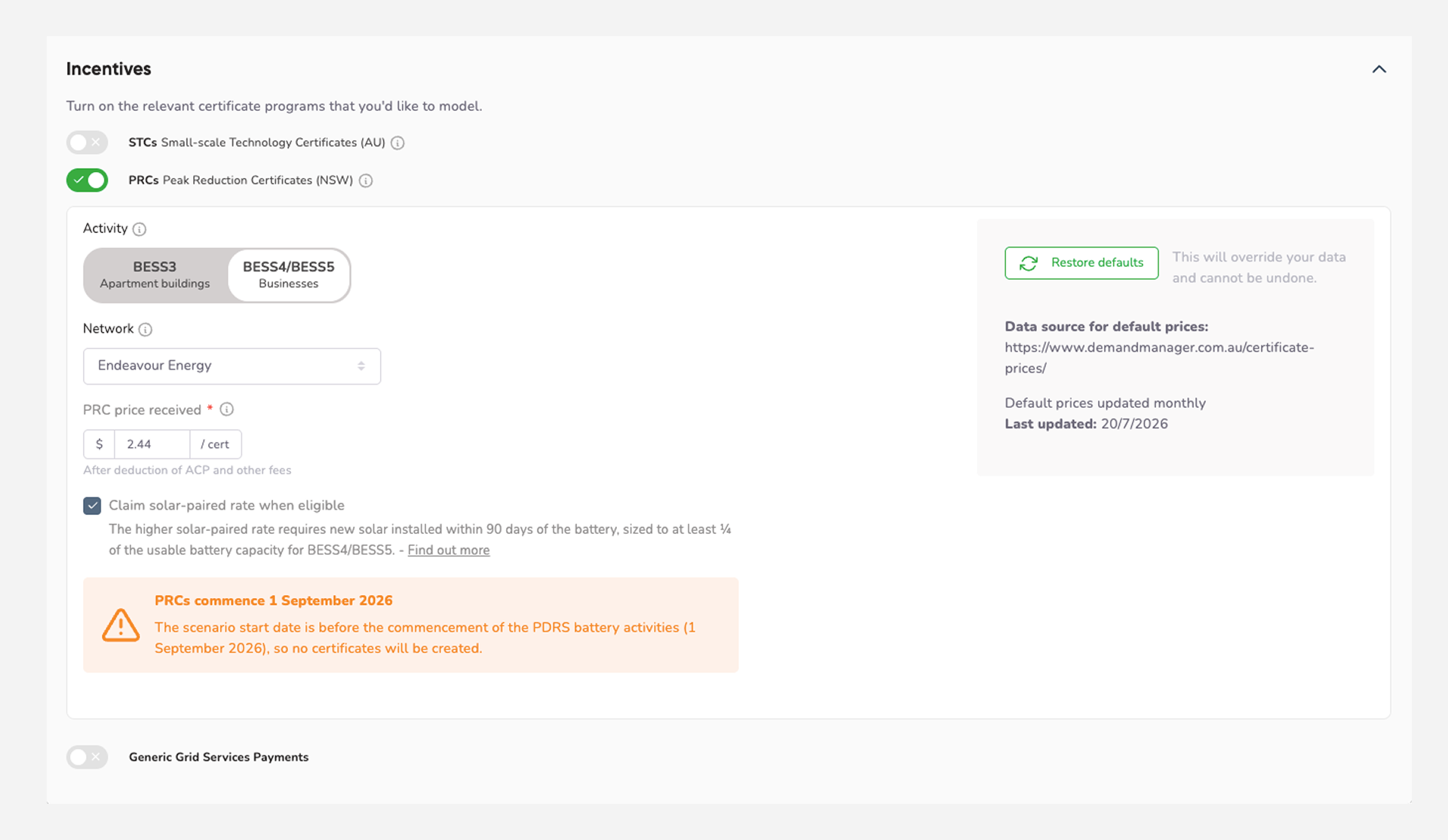
Inside Plan, PRCs are now a toggle. Add your battery, open the Incentives panel on a NSW site, switch PRCs on, pick the activity and network, and Plan applies the correct activity, handles both caps automatically, and drops the value into your cash flow as an upfront discount. No spreadsheets, no manual cap logic.
If the scenario includes solar, Plan automatically claims the higher solar-paired rate. For staged installations where the solar comes later, untick the solar-paired option to model the battery-only rate.
The certificate price defaults to a current market estimate we update monthly, but it's editable if you have a confirmed price from your ACP. Either way, treat it as an estimate and confirm live pricing before finalising a customer quote.
One thing to watch: make sure your project start date is September 2026 or later. Plan will flag a warning if it isn't.
Try it now
Open a NSW battery scenario in Plan, set the project start date to September 2026 or later, and toggle on PRCs. See what the discount does to your customer's payback — then click "Find out more" in Plan for the full calculation detail and eligibility notes.
Happy modelling!
Get your 3 week free trial
Get started exploring energy project feasibility analysis and reporting. Sign up now - no credit card required.