Blog /
Product Features
Modelling sites with Existing Solar just got seamless in Orkestra
January 14, 2026
Australia's C&I solar sector is booming. The 15-100 kW commercial segment grew by 16% in 2024 to record its best year ever, and in 2025, those customers started coming back for batteries.
With Australia’s federal battery rebate expanding to $7.2 billion in funding for battery installations (DCCEEW), the demand is real. In fact, our recent C&I Solar and Battery Census reported that 4 out of 5 customers ask about batteries - many of them with existing solar installed.
But this shift has created a modelling challenge that's been slowing down installers and energy consultants across the industry. Working with sites that have existing solar can be tough. Sometimes you get interval data from the retailer- but it only shows grid consumption after solar has already reduced the load, not the site's actual energy use. Other times you have no performance data from the existing PV system at all. Either way, you're stuck manually piecing together what the site's true baseline looks like before you can even start sizing a battery. Sound familiar?
While you could always model these scenarios in Orkestra, we knew we could make it better, so we've completely rebuilt the site setup workflow to streamline the process, and make working with existing solar faster and easier than ever.
To help guide you through the new setup in Orkestra Andie and Jake have put together a short walkthrough video to guide you through the new site basline for modelling sites with existing solar.
Get your 3 week free trial
Get started exploring energy project feasibility analysis and reporting. Sign up now - no credit card required.
Sign up todayWhat's New in the Site Baseline
Orkestra's rebuilt site baseline feature addresses these challenges head-on with capabilities designed specifically for real-world scenarios:
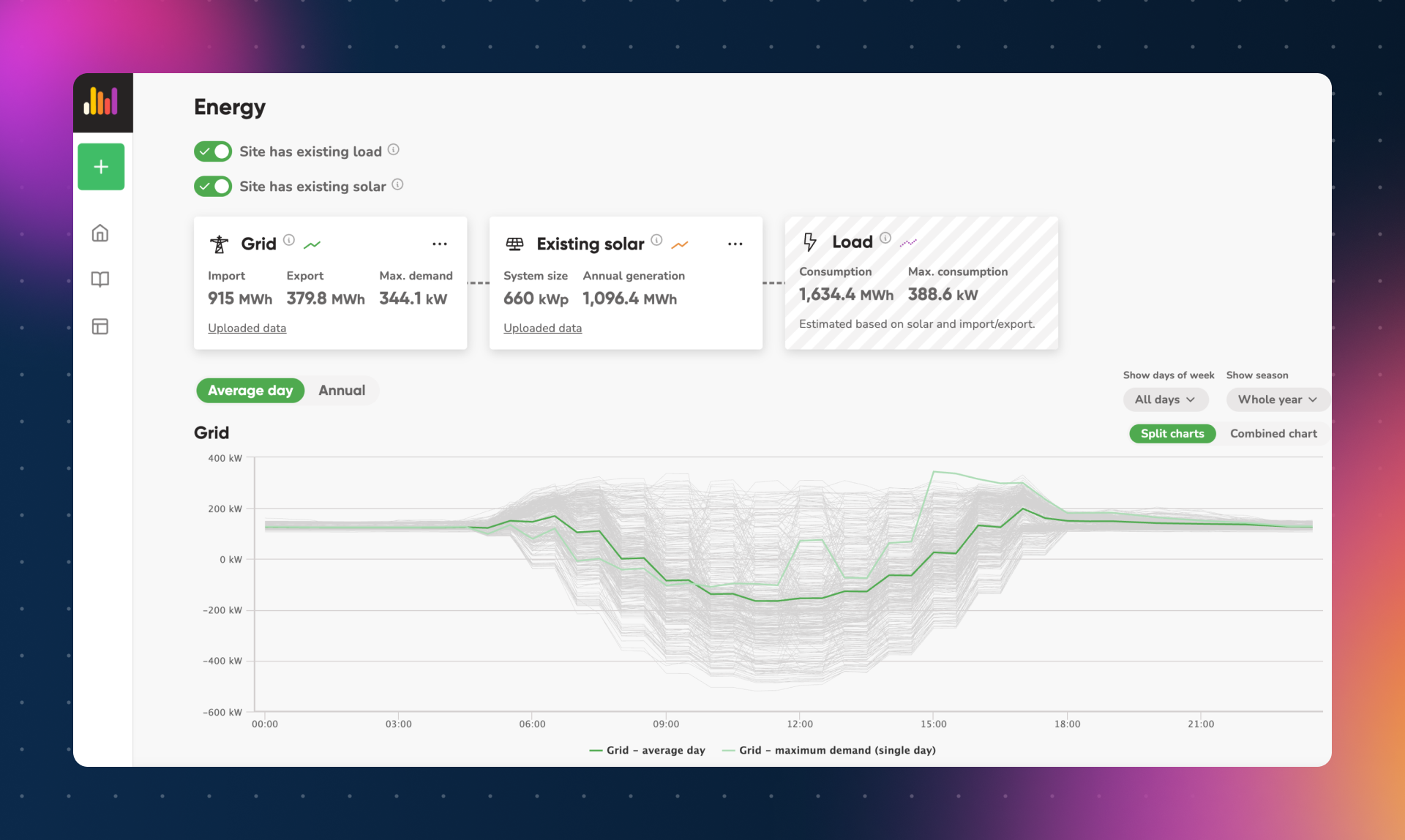
Simulate missing solar generation data: Don't have performance data from the existing PV system? Simply input the system specifications -capacity, inverter size, orientation, pitch, system age, and degradation rate, and Orkestra will simulate what that system is producing and calculate the site's true consumption profile. No more guesswork or manual calculations.
Clearly distinguish data types: When uploading interval data, you can now specify exactly what that data represents - grid consumption, solar generation, or site load. This prevents the common error of accidentally overlaying and double-counting existing PV production, which plagued the previous workflow.
Build an optimisation-ready baseline: By treating grid import/export and existing solar as first-class inputs, Orkestra produces a clean, defensible baseline that reflects how the site actually operates today. This ensures every scenario you test - batteries, additional PV, or both, is evaluated against a consistent and accurate starting point.
Baseline accuracy that reflects local reality: The site baseline automatically incorporates location-specific factors such as network tariffs and regional conditions. What works financially in North Queensland may not in Melbourne, and Orkestra ensures your baseline reflects those realities before any optimisation begins.
Model With Confidence and Close Deals Faster
The new site baseline feature is already live in Orkestra and ready to handle projects with existing solar. Whether you’re adding batteries to current installations, revisiting sites you’ve already sold, or evaluating hybrid solutions across different network tariffs, the streamlined workflow makes complex analysis straightforward.
You can now model sites with existing solar using real grid import/export data, giving you a faster and more accurate baseline without manual preprocessing - even for projects that were originally sold before this workflow existed.
Log in to Orkestra to model your first site with existing solar, or start a free trial to experience how much faster and more accurate your feasibility analysis can be.
Need assistance getting started with the new features? Reach out to our team - we're here to help you make the most of these capabilities and close more deals with confidence.
Book a Demonstration
Book a meeting with the Orkestra team in your region