Blog /
Industry Insights
2026: The Year C&I Solar and Batteries Hit Their Stride in the UK
February 2, 2026

Written by Mark Gardiner, Head of Sales (UK & Ireland) at Orkestra, in conversation with Gus Pitfield - Head of Commercial, Midsummer Energy
The UK solar market just had an extraordinary year. Solar generation jumped 30% in 2025, supplying a record 6.3% of Great Britain's power - enough to power 4.6 million homes. Capacity surged 18% to reach around 23.8 GW by year's end, driven by record rooftop installations and major ground-mount projects.
Within that broader boom, C&I solar is gaining serious momentum. Commercial rooftops added 450 MW of capacity in 2025, and the fundamentals driving this growth are only getting stronger: corporate net-zero commitments translating into real projects, direct bill savings that are impossible to ignore, and the perfect match of large daytime loads with suitable roof structures.
Looking at more mature C&I markets like Australia and Germany, where commercial solar has become a cornerstone of the energy transition, the UK appears poised for similar acceleration. To understand what's driving this opportunity and where it's headed, I recently sat down with Gus Pitfield, Head of Commercial at Midsummer Energy.
What We Saw in 2025
Our conversation started with the reality on the ground: who actually won C&I solar and battery projects in 2025?
According to Gus, it wasn't the companies avoiding complexity, it was those embracing it. The winners were "those who've made a step towards using complexity to unlock value accurately."
The best players were asking the right questions early, requesting 12 months of half-hourly consumption data, understanding load profiles, and mapping out where batteries could capture the most value. They understood the technology deeply enough to know which applications would deliver the strongest returns. And critically, they were modelling accurately with sophisticated tools rather than rules of thumb, demonstrating how batteries capture value through peak shaving, load shifting, tariff optimisation, and grid services.
But here's the sobering reality: Gus suspects only 10-20% of the market have embraced this approach. That gap represents a massive opportunity for those willing to invest in building this capability.
The Accelerants: What’s Changing in 2026
So what's actually changing in 2026 that will accelerate C&I battery adoption? Gus and I identified several forces converging at once:
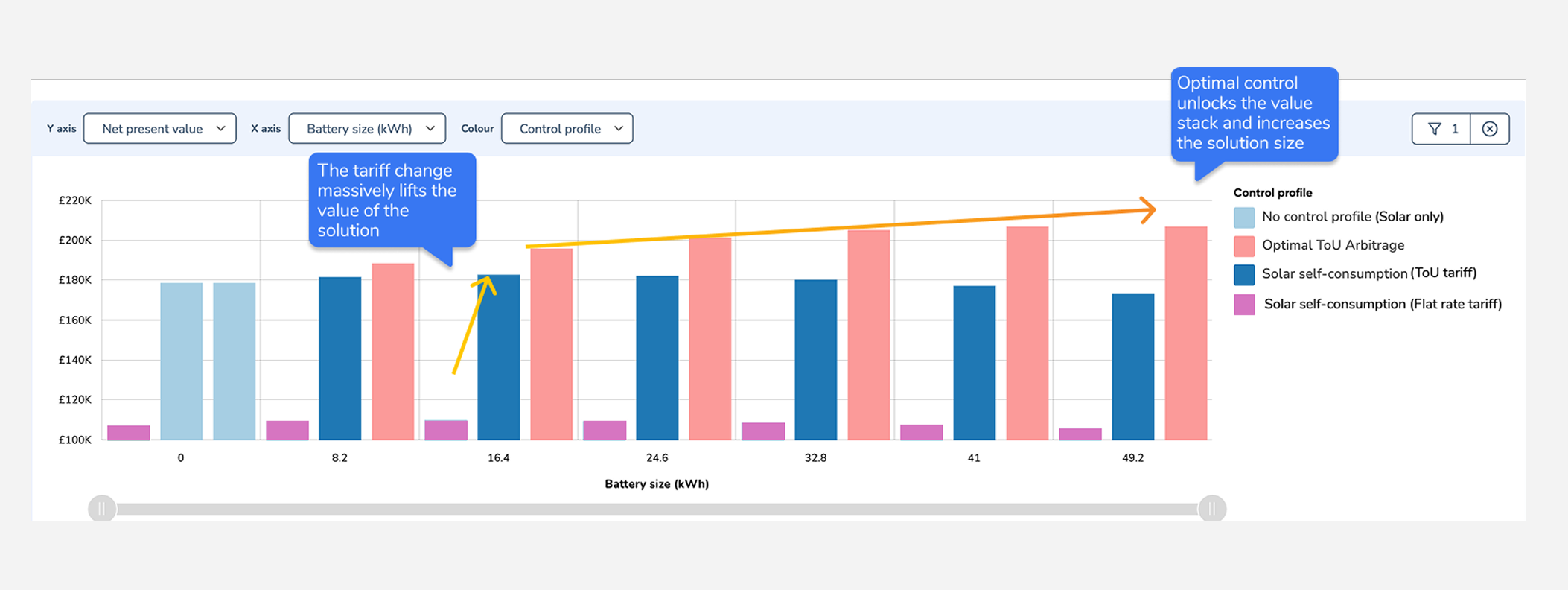
Tariff structures are evolving. Dynamic pricing and incentive structures that reward flexibility are essential for battery economics. Without tariffs that allow batteries to capture value through time-shifting and optimisation, payback periods remain challenging. The UK is finally moving in this direction.
Modelling technology has arrived. This is perhaps the biggest shift. Orkestra launched in the UK in 2025, fully localised to handle the complexities of the UK energy market with ease. The platform includes a comprehensive public library of tariffs that installers can use to compare and evaluate project financials - transforming what used to take days of spreadsheet work into accurate modelling in minutes. For the first time, sophisticated battery modelling is accessible to installers and developers at scale, removing the technical barrier that's held back the market.
Energy management systems are maturing. Every major battery manufacturer now offers intelligent EMS platforms that optimise based on weather forecasts, historical load data, and real-time pricing. The convergence of control intelligence with hardware capability is creating the ecosystem needed for optimisation at scale.
DC-coupled solutions are arriving. Larger three-phase hybrid inverters in the 50-150kW range represent a potential game-changer for C&I. As Gus explained, "2026 may see a lot of the big AC-coupled systems we were looking at being replaced by big DC-coupled solutions, which avoid some of the issues with the way DNOs view AC coupled battery storage." They sidestep grid connection challenges, reduce system losses, and simplify approvals.
The Australian preview. Australia's wholesale market (a few years more mature in solar penetration) offers a glimpse of where the UK is headed. As solar penetration increased, wholesale market dynamics shifted dramatically. In South Australia in particular, negative pricing events accounted for 25% of trading periods in 2024, with prices swinging from thousands of dollars per MWh to negative within hours - creating significant arbitrage opportunities for batteries. For UK businesses installing solar and batteries now, this volatility preview is encouraging: the bigger the price swings between solar generation periods and peak demand, the more valuable battery storage becomes. As UK C&I solar scales, we expect similar dynamics will emerge, making battery flexibility increasingly valuable.
The Battery Business Case
This is where our conversation really crystallised: batteries aren't just an add-on to C&I solar, they're the catalyst that transforms the entire value proposition.
When properly modelled and deployed, batteries unlock multiple revenue streams simultaneously: peak shaving to reduce demand charges, tariff optimisation to capitalise on time-of-use pricing, and grid services that generate additional income. But as Gus emphasised, success comes down to one thing: modelling accuracy.
"We've hit a good price point per kilowatt hour," Gus told me. "If we can model batteries better, that's going to help us unlock their potential and help make the investment case to end client decision makers."
The challenge isn't the technology anymore, it's demonstrating the financial returns clearly enough that customers understand the business case. That means moving beyond simplified payback calculations to sophisticated modelling that captures all revenue streams and shows the real impact on their bottom line.
Critically, this also includes matching the right tariff structure to each site. Battery value varies dramatically depending on whether a business is on a time-of-use tariff, has demand charges, or can access flexibility services. Without comparing tariff options alongside battery configurations, you're likely leaving significant value on the table.
This is where having the right modelling tools changes everything. As Gus noted in our conversation, platforms like Orkestra enable installers to compare hundreds of solar, battery and tariff configurations for their specific site, and demonstrate the financial impact and value stack of each option. This capability to show customers clear, data-driven comparisons across different scenarios is what transforms complexity from a barrier into a sales advantage.
If you're interested in exploring how this works in practice, we offer a 3 week trial of Orkestra where we guide you through setting up your first project - completely free. You can sign up here
Get your 3 week free trial
Get started exploring energy project feasibility analysis and reporting. Sign up now - no credit card required.
Sign up todaySolar Trends Worth Watching
Solar PV pricing: After years of declining costs, solar panels may see price increases in 2026, potentially shifting investment towards battery capacity relative to generation capacity.
Battery pricing: Competing pressures are at play - rising lithium prices and premium new technologies versus ongoing manufacturing efficiencies. The trajectory for 2026 remains uncertain.
Sodium-ion: Midsummer's residential experience with Eleven Energy’s sodium-ion batteries offers encouraging insights for C&I applications. They're price-competitive with lithium, perform comparably (or better in cold temperatures), and are more sustainable. The only trade-off is 10% lower energy density - negligible for most C&I installations. A three-phase sodium system for smaller C&I applications is coming in 2026. For more details on Sodium batteries from Midsummer check out this page.
The Path Forward
The C&I solar and battery market is maturing rapidly, and 2026 feels like an inflection point. The technology is ready. Tariff structures are improving. Grid connection processes are evolving. And critically, the tools to accurately model and communicate battery value are now available.
What used to be a barrier- the complexity of modelling batteries properly - is now an opportunity. Platforms like Orkestra enable installers and developers to embrace that complexity, running detailed scenarios that show customers exactly how batteries will impact their bottom line across multiple revenue streams.
As Gus put it: "As a solar installer, being one of those 10 - 20 percent is exceptionally lucrative. If you can sell a battery properly and you can make the business case for selling it, the outcome financially is really exciting for your business."
Success will favour those who lean into rather than shy away from sophisticated modelling. For installers and developers, that means using tools that deliver the depth customers need to make confident decisions. For PPA providers, it means exploring new revenue structures enabled by battery flexibility. For manufacturers, it's about delivering intelligent control systems that make optimisation accessible.
Our conclusion? The opportunity is massive. The companies that can accurately demonstrate battery value through detailed modelling, data-driven conversations, and clear ROI projections will capture a disproportionate share of a market that's ready to scale.
Midsummer Energy offers everything you need for your C&I solar and battery project; with a strong focus on product knowledge, customer support and keen pricing, they are here to help! For commercial projects email commercial@midsummerenergy.co.uk or call them on 01223 851535 and ask for someone in the commercial team.
Interested in modelling C&I solar and battery projects with confidence? Orkestra enables installers and developers to accurately assess battery value across multiple scenarios, helping you present compelling business cases to customers.
Book a Demonstration
Book a meeting with the Orkestra team in your region