Blog /
Industry Insights
The Hidden Cost of Data Silos for PPA Operators
April 27, 2026

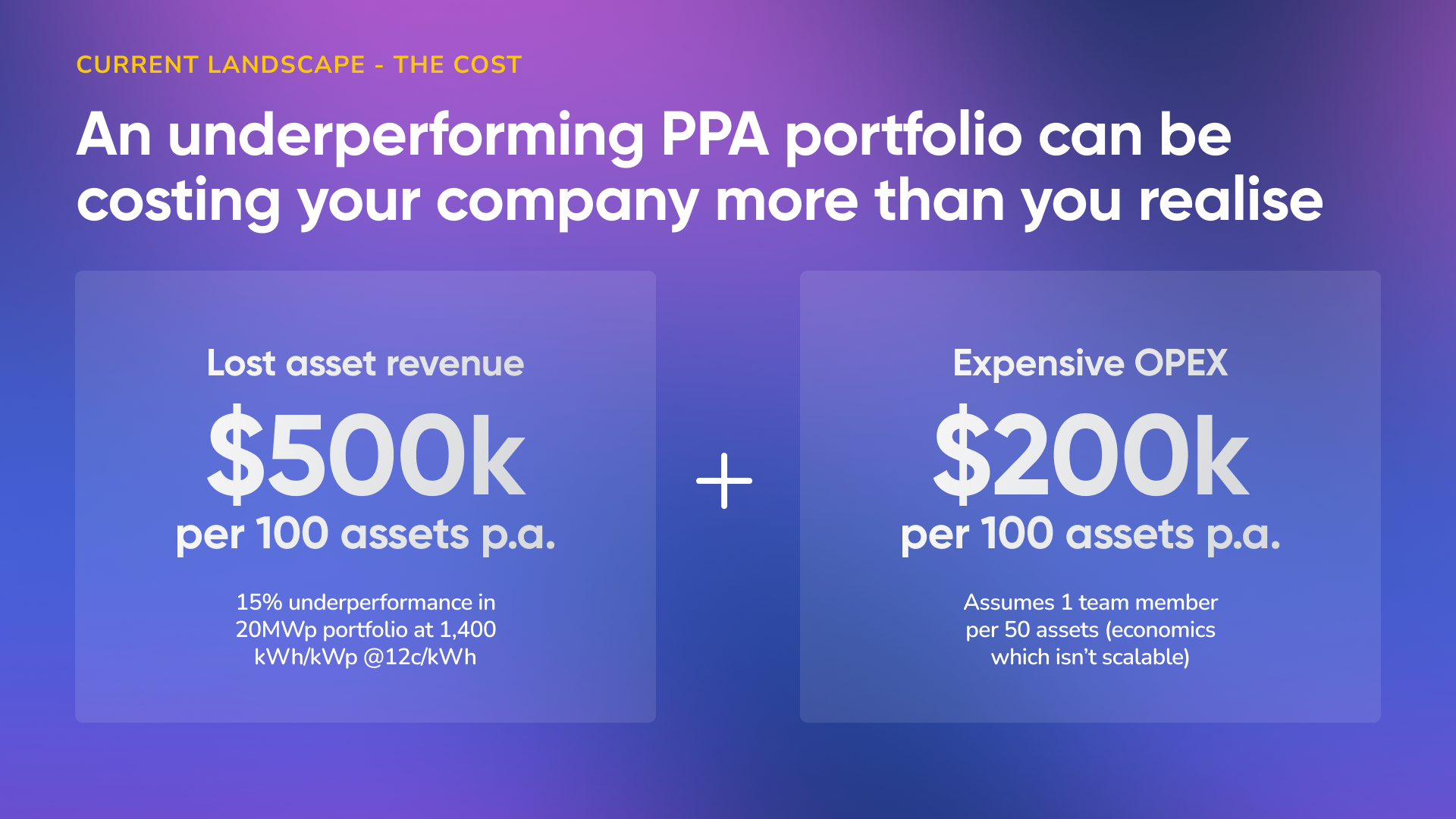
A 20MWp C&I portfolio underperforming by 15% loses more than $500,000 in PPA revenue annually. Most operators don't find out until their monthly review.
That's not a worst-case scenario. Based on what we've seen across more than 100 conversations with operators and asset managers across APAC, the UK, and Europe, it's closer to common for teams running passive management processes.
The problem isn't that operators aren't paying attention. It's that the tools and processes most teams rely on aren't designed to catch the right issues in time. In this blog, we'll walk through why this happens, why it gets worse as you scale, and the seven-step framework we built to solve it.
The monthly reporting trap
Most PPA operators report on portfolio performance monthly. Data gets collated, a report gets produced, findings get reviewed. By that point, an underperforming asset may have been losing revenue for weeks.
Here's what that actually looks like. An inverter string goes down in the first week of the month. The system is still generating, just not at full capacity. The meter data looks broadly normal at a glance. The deviation doesn't get flagged until the next monthly report is produced, reviewed, and investigated. The site visit happens three weeks later. Issue resolved.
That's 2 months of lost generation. Multiply that across a portfolio of 100 assets where several are experiencing similar issues at any given time, and the revenue impact becomes significant fast.
The answer isn't more frequent manual reporting. It's removing the lag between a performance issue occurring and someone knowing about it.
The headcount problem nobody budgets for
The revenue loss is one side of the problem. The operational cost is the other.
A single person can manage around 50 assets before the workload becomes unsustainable. For a 100-asset portfolio, that's 2 people in day-to-day operations, $200,000 in annual OPEX just to keep the lights on administratively.
Where does that time actually go?
Billing alone consumes 2–3 days every month per 100 assets: exporting data, running checks, replacing data gaps, connecting PPA contract details, formatting invoices. When a meter goes offline, someone manually sources interval data from the inverter portal and uploads it to the client portal to fill the gap. Customer queries, often about why energy bills have increased despite having solar, can eat up to a day a month to work through. (The glamorous reality of exporting CSVs at month-end is something every operator knows well.)
None of this is active asset management. It's administration. As portfolios scale, the administrative burden scales with them, faster than revenue does. To be clear, this isn't about reducing headcount or replacing anyone. It's about giving your team the right resources to manage a portfolio twice the size, without twice the admin.
The root cause: data that doesn't connect
We heard it across those 100+ conversations with operators and asset managers. Again and again, the same answer.
The data is stuck in silos.
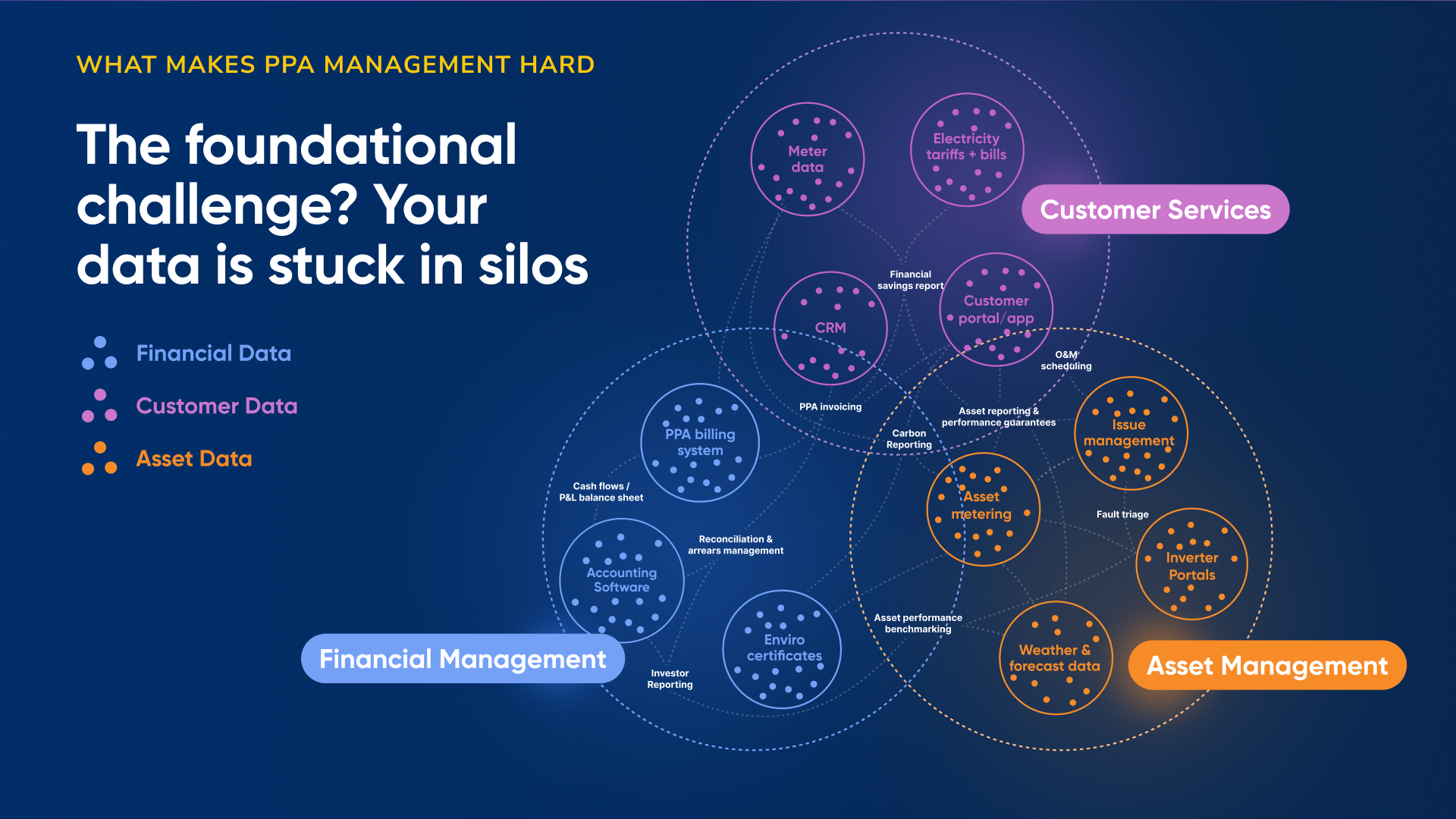
Managing a PPA portfolio requires pulling together three distinct categories of data:
- Asset data: generation, meter readings, weather, inverter configuration, performance forecasts
- Financial data: PPA billing, accounting systems, environmental certificates, investor reporting
- Customer data: electricity tariffs, financial savings, CRM, client-facing portals
Each of these lives in a different system.
And this is where it gets interesting, because the problem isn't your team. It's that the data was never designed to connect in the first place.
Because they don't connect, every workflow that depends on them requires manual intervention. Data gets exported, reformatted, merged, and re-imported, every month, across every asset.
This is why automation is so difficult. It's not a technology problem in isolation, it's a data architecture problem. And until the data is unified, the manual overhead doesn't go away regardless of how capable the team is.
Join The Operators
Get actionable C&I briefing insights to help navigate real operational challenges across energy assets.
Sign UpWhat changes when you fix it
When all relevant data flows into a single platform automatically, a few things become possible that weren't before.
This is what Operate is built to do.
1. Real-time performance detection. Instead of finding out at month-end that an asset has been underperforming for three weeks, deviations get flagged as they happen. You're acting on yesterday's data, not last month's.
.png)
2. Billing becomes exception management, not production work. Rather than manually processing every asset every month — exporting, reconciling, formatting, billing becomes a process of reviewing what's been flagged. The routine work disappears; the edge cases get your attention.
.png)
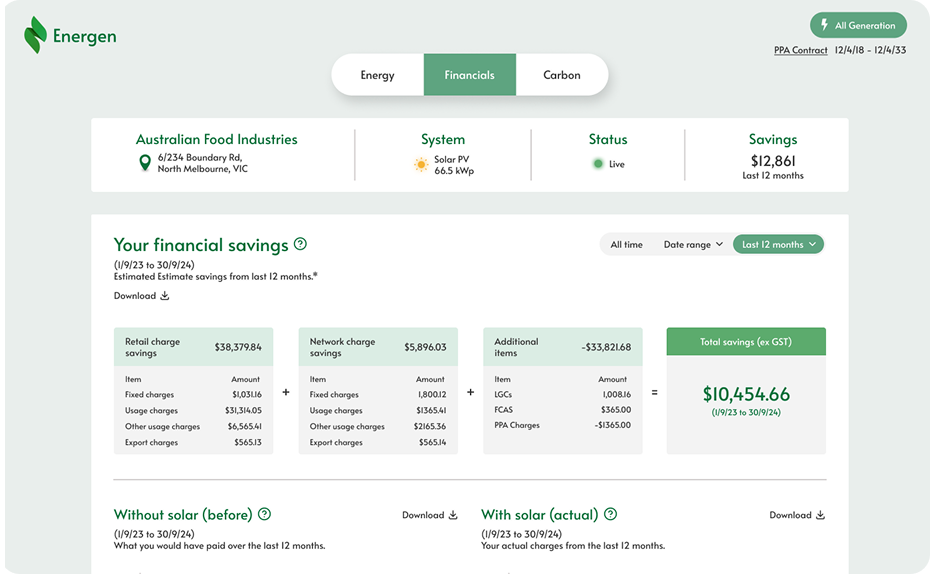
3. Customer reporting runs itself. Instead of producing reports as a time-consuming exercise each month, live dashboards update automatically. Your team stops producing information and starts using it.
4. Issue prioritisation gets smarter. Rather than responding to whichever alert came in most recently, your team can see which problems are costing the most revenue and act accordingly.
.png)
The operators managing this well aren't necessarily larger or better resourced. They've simply changed the underlying architecture of how their data flows, and built their operations around that foundation.
How you can achieve this? A framework built from the ground up
Earlier this year, we hosted a webinar: Scale Your PPA Portfolio: Without the Overheads, where we presented a technology-first framework built directly from those operator conversations.
The 7-step framework to profitably scale PPA portfolios is a practical, sequential playbook for operators who want to move from reactive to proactive portfolio management.
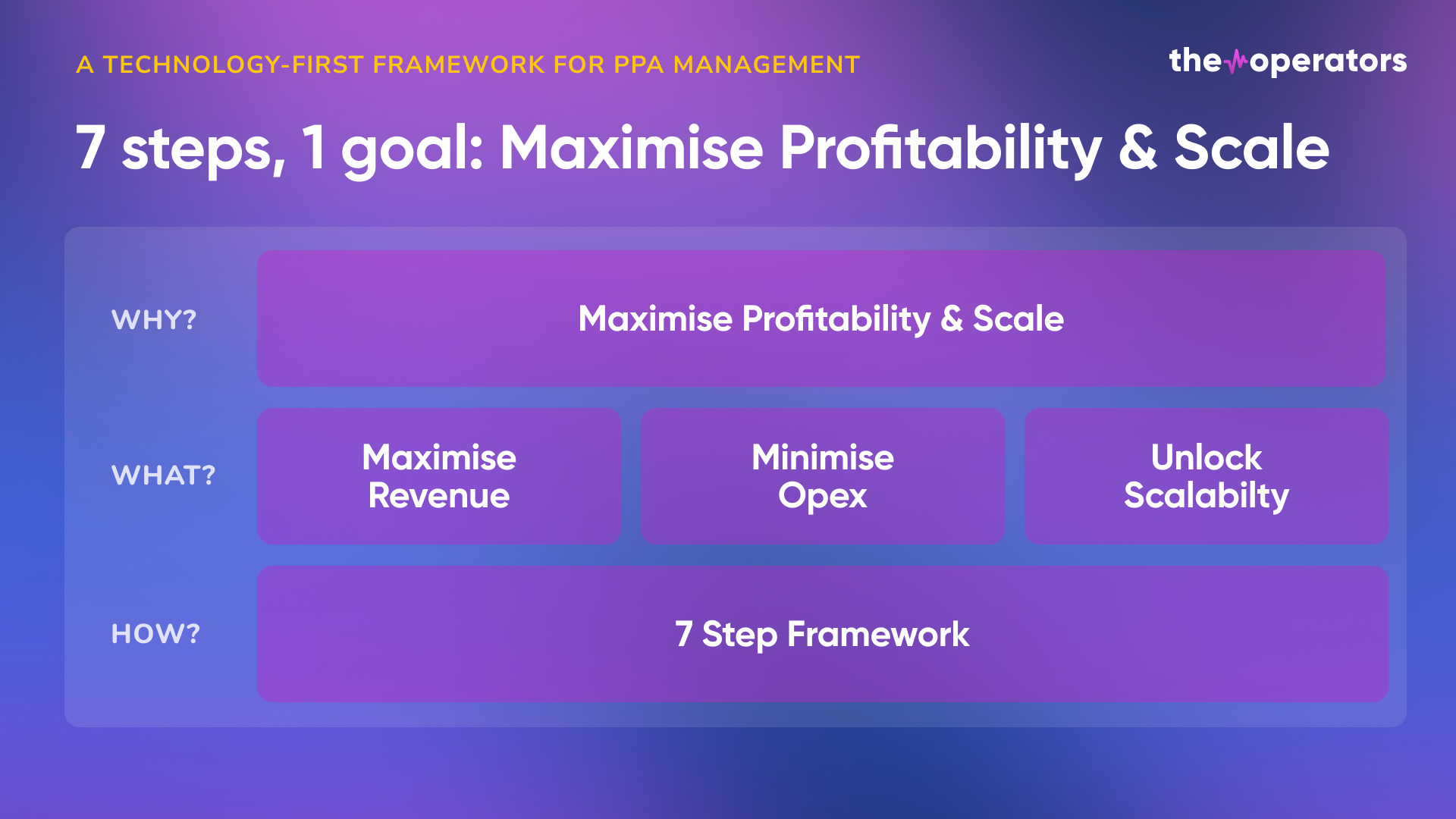
It addresses the data problem at its root, and builds from there.
This framework gives you the operational foundation for a portfolio that can scale to 500+ assets without the headcount growth that scale typically demands.
The full framework is available now to download.
Access the 7-step Framework
Get actionable steps to eliminate data silos, automate operations, and profitably scale PPA portfolios.
The bottom line
Underperformance at scale is not inevitable. It is largely a consequence of operating without the right data architecture, the right processes, and the right visibility - problems that are solvable.
The operators getting this right aren't doing more work. They're doing different work, because their systems surface the right information at the right time, and their teams spend their time acting on it rather than producing it.
If your portfolio has grown faster than your processes have, or if billing and reporting are consuming more of your team's time than active asset management is, the framework is worth your time.
The full report is available to download now - practical, actionable, and built from real operator experience. Download the 7-step framework report
Keen to see it in action with your own data? Register for the Operate Pilot program. We open 10 pilot spots each month for teams ready to get their assets into Operate - real data, real assets, hands-on support! Save your pilot spot here.