Blog /
Industry Insights
Germany's Battery Playbook: Unlocking Atypische Netznutzung Tariffs
July 1, 2026
At a Glance
- Germany's § 19 Abs. 2 StromNEV framework allows C&I sites to negotiate a lower individual network tariff (individuelle Netzentgeltvereinbarung) if peak demand falls outside the Netzbetreiber's published high-load time windows (Hochlastzeitfenster).
- For most industrial sites, cold stores, food processing, automotive plants, a correctly sized commercial battery (Gewerbespeicher) is the only practical way to achieve the required demand reduction.
- Battery sizing (Speicher-Auslegung) is the critical execution risk: too small means ineligibility; too large means financially unviable utilisation.
- Our Pharmazeutisches Kühllager Bremen case study shows the optimal solution delivers 13% IRR and €285,000 NPV over 15 years.
Germany's network charge framework contains one of the most powerful value mechanisms available to C&I battery projects: atypische Netznutzung (atypical grid usage). For the right site, a correctly sized battery can unlock a Netzentgeltoptimierung (network tariff optimisation) worth thousands of euros per year, but only if the project is modelled and sized with eligibility as a hard constraint.
This playbook explains how the mechanism works, how to identify candidate sites, and why getting the battery size right is so critical.
How does the atypische Netznutzung tariff structure work?
Under § 19 Abs. 2 Satz 1 StromNEV, commercial and industrial customers are entitled to an individuelle Netzentgeltvereinbarung (individual network charge agreement) if their consumption pattern is classified as atypisch, meaning their peak demand falls outside the Netzbetreiber's (network operator's) designated high-load time windows rather than coinciding with them.
Each Netzbetreiber publishes its Hochlastzeitfenster (HLZF) annually. These are defined periods, typically working-day mornings and evenings during winter months, when demand on the local network is at its highest. Weekends, public holidays, bridge days, and the Christmas–New Year period are automatically excluded.
A customer whose peak demand during these windows is predictably and significantly lower than their annual peak (Jahreshöchstlast) can enter into an individuelle Netzentgeltvereinbarung with their Netzbetreiber. Under this agreement, the Leistungspreis is calculated using only the peak demand measured during the Hochlastzeitfenster periods, rather than the annual peak. Because a qualifying customer's demand during those windows is substantially lower, the billable demand figure, and therefore the capacity charge, falls accordingly.
What makes a project eligible for atypische Netznutzung?
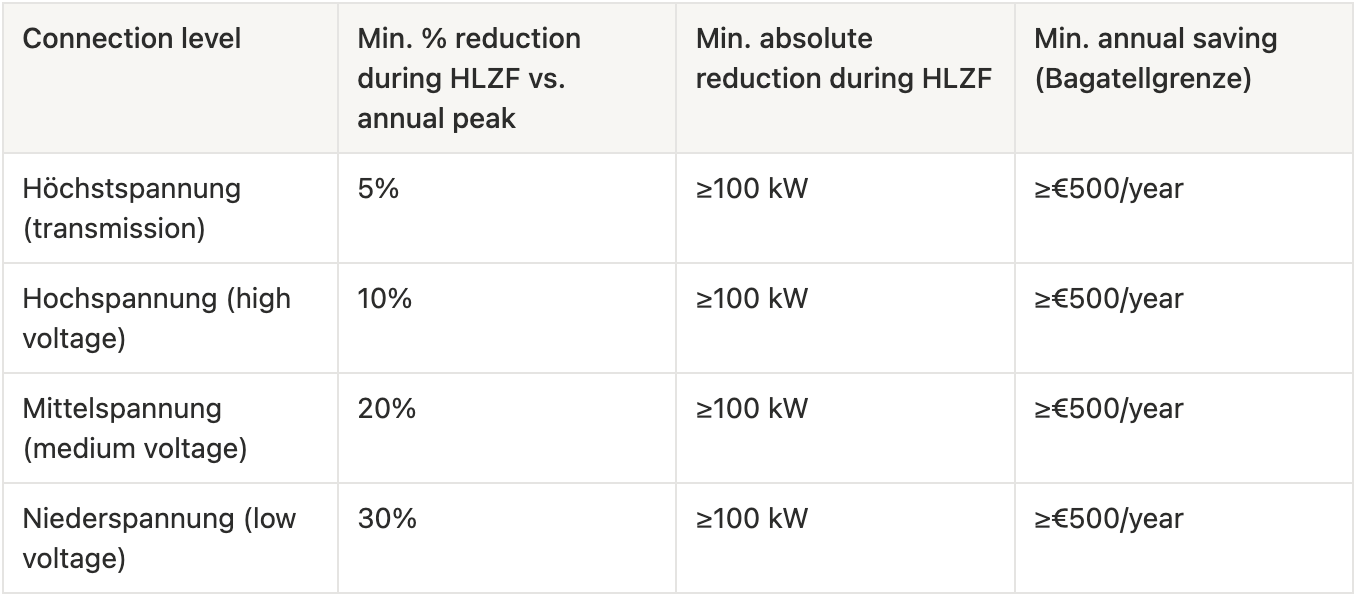
To qualify, a site must satisfy all three of the following thresholds simultaneously.
Why do most sites need a battery (Gewerbespeicher) to qualify?
Industrial sites with continuous shift-driven operations, such as cold stores, food processing facilities, automotive plants, and logistics hubs, characteristically produce peaks at predictable times: shift starts, refrigeration cycles, machinery commencement. These spikes frequently occur during the same morning and evening windows that coincide with the Netzbetreiber's highest network load. Without intervention, the site's Lastprofil (load profile) during the Hochlastzeitfenster remains too high to qualify for atypical classification, and the site cannot meet the minimum percentage reduction.
A correctly sized Gewerbespeicher addresses this directly. By discharging during the Hochlastzeitfenster, a form of Peak Shaving (Lastspitzenkappung), it reduces the site's apparent demand below the qualifying threshold.
The commercial significance of this is considerable. The battery is not simply generating value through energy arbitrage or self-consumption optimisation. It is unlocking access to a tariff regime that the site cannot reach by any other means. That distinction is important for how the project economics are framed and how the investment case is presented to a customer.
How do you identify a site that is an ideal candidate for atypische Netznutzung?
Not every German C&I site represents a viable opportunity. The following factors indicate sites where a Gewerbespeicher may unlock the value of atypische Netznutzung.
Strong indicators:
- 24/7 operations with shift-driven peaks: Predictable load peaks visible in the half-hourly Lastprofil, with near-continuous operations. These sites already have high utilisation hours; the issue is peak coincidence with the HLZF, not total consumption.
- Annual consumption ≥1 GWh: Large enough to generate material Netzentgelt savings, and sufficient energy demand to support a battery large enough to meet the 100 kW absolute reduction threshold.
- Peak demand (Jahreshöchstlast) ≥200 kW: The minimum scale at which a battery can meet the 100 kW demand reduction threshold and still be cycled often enough throughout the year to achieve financially viable utilisation.
Factors that reduce viability:
- Unpredictable or highly variable load profiles: Difficult to guarantee consistent HLZF compliance across a full year.
- Low-voltage (NS) connections: The economics are typically less compelling and the percentage reduction hurdle (30%) is higher than for Mittelspannung (MS)-connected customers.
Why is battery sizing (Speicher-Auslegung) for atypische Netznutzung so complex?
Speicher-Auslegung for an atypische Netznutzung project is constrained in both directions. Too small and the site cannot achieve the required demand reduction during the Hochlastzeitfenster. Too large and the battery investment is overcapitalised and cannot be cycled frequently enough to reach a financially viable utilisation rate. The optimal configuration sits in the range that clears the eligibility threshold without exceeding what the site's energy throughput can justify.
Too small: ineligible for the tariff
A smaller battery will often show stronger financial metrics on paper with lower upfront cost, shorter payback period and higher rate of return. If the model applies the atypical tariff saving regardless of whether the battery can actually sustain the required demand reduction, those metrics are materially overstated. The Netzbetreiber will not grant the tariff change if the site's HLZF demand does not meet the required thresholds.
Too large: financially unviable utilisation
An oversized battery introduces a different problem. The capital cost scales with capacity, but the number of cycles the battery can complete is constrained by the site's actual energy throughput. A battery significantly larger than the site's Lastprofil can absorb will sit partially idle, reducing its effective utilisation rate and spreading its fixed costs across too few discharge events. The result is a project that clears the eligibility threshold comfortably but delivers returns that do not justify the additional capital deployed.
Case study: Pharmazeutisches Kühllager Bremen
.png)
Pharmazeutisches Kühllager Bremen is an example of an ideal atypische netznutzung site. The site is a pharmaceutical cold store operating 24/7 in Bremen. The site maintains continuous refrigeration for temperature-sensitive pharmaceutical products, with small demand peaks occurring at shift starts as staff and equipment load cycles interact.
Site parameters:
- Annual consumption: 1,827.6 MWh
- Annual peak demand (Jahreshöchstlast): 276.4 kW
- Retail tariff: Simple Industrial Day & Night
- Current network tariff (Netzentgelt): Wesernetz MS ≥2,500 h jährlich
- Target network tariff: Wesernetz MS ≥2,500 h Atypische
How does Orkestra identify the optimal solution?
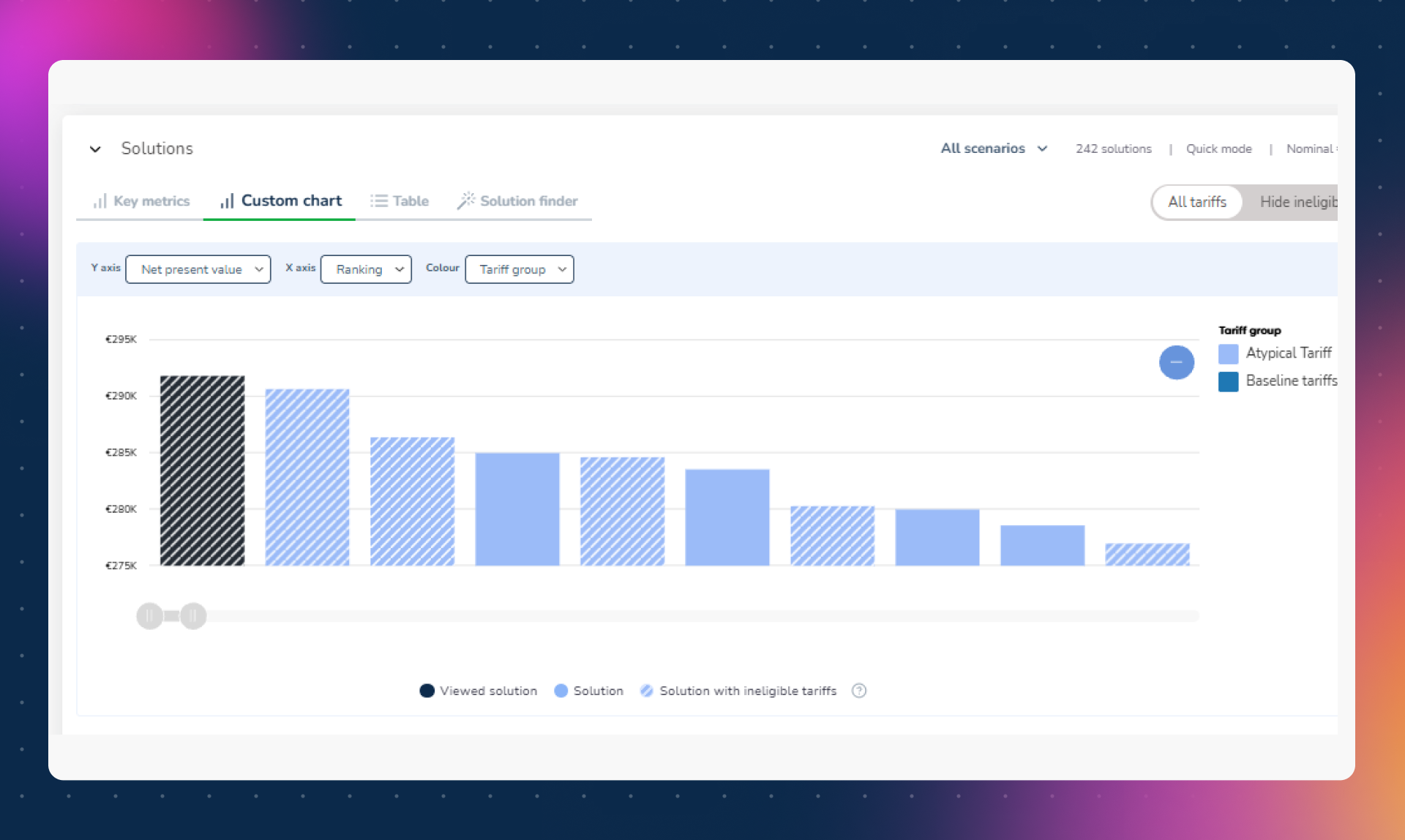
Orkestra Plan evaluates the full solution space simultaneously, in this case, 242 combinations of solar and battery sizing across both standard and atypical tariff scenarios. Plan models tariff eligibility as a hard constraint, solutions carrying the atypical tariff saving are only eligible where the battery can genuinely achieve the required demand reduction.
Insight 1: The atypical tariff dominates the highest-value solutions
Across all 242 solutions modelled, atypical tariff scenarios (shown in light blue) are consistently clustered at the top of the NPV distribution. All ten of the highest-value solutions are assuming an atypical tariff structure. The network charge reduction available through the atypische netznutzung is large enough to materially separate solutions from the baseline normal tariff structure, independent of solar or battery sizing. For this site, pursuing an atypical tariff is the principal value driver, the next test is to make sure that these options are achievable.
.png)
Insight 2: The highest-performing solutions by headline metrics are ineligible
This is the critical finding. The three highest-ranking solutions by IRR and NPV all carry an ineligibility flag. They incorporate the atypical tariff saving but use a battery too small to sustain the required demand reduction during every Hochlastzeitfenster window.
.png)
What is the optimal combination of solar & batteries to achieve an atypische netznutzung tariff?
.png)
The highest-value eligible solution across all 242 scenarios is a 500 kWp solar array paired with a 160 kWh / 80 kW battery on an atypical tariff. This combination is optimal because the atypische Netznutzung qualification sets the minimum viable battery size, and once that constraint is met, the solar and battery can be sized together to maximise total project return.
The 500 kWp solar and 160 kWh battery working together is large enough to hold site demand below the required threshold consistently throughout the year. The result: the project delivers the highest NPV in the solution set, with a 13% IRR and €285,000 NPV over 15 years.
Summary
Atypische Netznutzung is one of the most compelling value mechanisms available to C&I battery projects in Germany.
Qualification requires meeting both a voltage-level percentage threshold and a 100 kW absolute demand reduction simultaneously during the DSO's published Hochlastzeitfenster. For most most sites a correctly sized battery is typically the only practical way to achieve this reliably.
The Speicher-Auslegung decision is the critical execution risk. The Pharmazeutisches Kühllager Bremen case study illustrates this precisely: a smaller battery produces better headline financial metrics but cannot hold site demand below the qualifying threshold, rendering those metrics meaningless.
The optimal 160 kWh battery solution clears the threshold, qualifies for the atypical tariff, and in combination with 500 kWp of solar delivers a 13% IRR and €285,000 NPV over 15 years.
Modelling this correctly requires treating tariff eligibility as a hard constraint. Projects sized without that discipline will consistently show returns that cannot be delivered in practice.
Modelling atypische Netznutzung is complex but in Orkestra, you can size the battery, quantify the tariff saving, and produce a clear, bankable feasibility report in minutes. Hand that to your customer and the value of the solar and battery system sells itself.
Start a free trial of Orkestra and use our built-in AI support to guide you through your first project.
For questions on atypical tariff modelling in Plan, or to request a new DSO tariff added to the database, contact the Orkestra team.
Get your 3 week free trial
Get started exploring energy project feasibility analysis and reporting. Sign up now - no credit card required.
FAQ
What is atypische Netznutzung? Atypische Netznutzung is a provision under § 19 Abs. 2 StromNEV that allows C&I customers whose peak demand consistently falls outside the Netzbetreiber's Hochlastzeitfenster to negotiate a lower individuelle Netzentgeltvereinbarung. The Leistungspreis is then calculated on the lower HLZF peak, not the annual Jahreshöchstlast.
Who qualifies for atypische Netznutzung? A site must meet all three eligibility thresholds simultaneously: the percentage reduction in demand during the Hochlastzeitfenster relative to the Jahreshöchstlast, the 100 kW absolute demand reduction and €500 savings threshold.
Why do most industrial sites need a Gewerbespeicher to qualify? Industrial sites with shift-driven operations typically produce peaks that coincide with the Hochlastzeitfenster. Without a battery performing Peak Shaving (Lastspitzenkappung) during those windows, the site's Lastprofil remains too high to meet the eligibility thresholds.
How large does the battery need to be? The battery must be large enough to meet the eligibility requirements, including reducing site demand by at least 100 kW during every Hochlastzeitfenster window across the full year.
What happens if the battery is oversized? An oversized industrieller Batteriespeicher cannot be cycled frequently enough to reach financially viable utilisation. The capital cost scales with capacity, but throughput is constrained by the site's actual energy demand. The result is a project that clears the eligibility threshold but delivers returns that do not justify the additional capital deployed.
What is the application deadline (Antragsfrist)? The Antragsfrist is 30 September each year. A written application for an individuelle Netzentgeltvereinbarung must be submitted to the Netzbetreiber before this date for savings to apply in the following year.
What savings are achievable? Savings depend on the site's Leistungspreis and the gap between its Jahreshöchstlast and its demand during the Hochlastzeitfenster. In Orkestra’s Pharmazeutisches Kühllager Bremen case, the optimal solution delivered a 13% IRR and €285,000 NPV over 15 years from the combination of the atypical tariff reduction and 500 kWp of solar.